“Calcutta Did Not Invite Him”: Up the Hooghly to Calcutta
The surf at Madras, the river pilots, and the city at the end of the road.
Eight months after leaving Newcastle, the ship in By Trade and by Trust reaches the mouth of the Hooghly, and a pilot comes aboard:
There the pilot, Greer, came aboard. He was an Englishman of about fifty, long employed in navigating the river, and took charge of the vessel with the readiness of one to whom such work was habitual. He guided them with the tides, moving with the floods and anchoring with the ebbs, urging patience at the bends, and saying little to Bingley, which Askew considered a considerable virtue in a river pilot.
This is the fourth part of The Road East. In Part 3 we left the Cape. Now we cross the Indian Ocean, call at Madras, and go up the river to Calcutta, the city at the end of the road.

Across the Indian Ocean
From the Cape a ship ran east and then north-east across the Indian Ocean, often calling nowhere for weeks. The great danger here was the monsoon: the winds of the Bay of Bengal blow from the south-west for half the year and from the north-east for the other half, and the change between them brings storms.
Constance meets one. In October a gale in the Bay of Bengal drives her south-west, and she shelters for nearly three weeks at Madras.
Madras Roads
Madras (now Chennai) was the Company’s oldest great settlement in India, and one of the strangest places to land in the world. It had no harbour. Ships anchored well offshore, in the open sea, in what were called the Roads. Between the ships and the beach ran a heavy surf that broke in three great lines of waves.
No ship’s boat could cross it. Everything and everyone went ashore in masula boats, tall open boats made of planks sewn together with coconut fibre instead of nails, so that they flexed rather than broke when the surf threw them onto the beach. Thomas Williamson, in 1810, describes them carrying “from forty to sixty tons” and pulled by ten to sixteen oars, passing “through the surf, both coming and going, with amazing facility”. Passengers were advised to wear a boat-cloak, for “the spray will rise around the boat, completely wetting whatever finery may be exposed to its action”.
Madras was also dangerous in the wrong season. From the beginning of October to the middle of January, Williamson says, the flagstaff on shore was taken down, “as a signal to vessels that no insurance is payable on account of such losses as may happen during that period”. Even the Navy’s warships left for safer harbours. Constance lies there in the autumn, at the very worst time of year. Bingley goes ashore only twice.
The Sandheads and the pilots
From Madras it was a week or so north to the mouth of the Hooghly, the westernmost branch of the Ganges, on which Calcutta stands.
This was the most dangerous water of the whole voyage. The coast of Bengal is so low that it can hardly be seen from the sea, and for miles out the river mouth is full of shifting sandbanks: the Sandheads. The channels between them moved from season to season. A stranger who tried them alone would very likely lose his ship.
So no ship tried. Off the Sandheads, near Saugor Island, the pilot vessels of the Company’s Bengal Pilot Service waited to meet incoming ships. A pilot came aboard and took command for the rest of the way. At night, Williamson writes, the pilot schooner showed the soundings with “flambeaux of an immense size, alternately exhibited and concealed in a large tub”. The service was strict: “no pilot who loses one of the Company’s ships is retained on the list: he is, ipso facto, dismissed.”
That is why Greer works the tides so carefully. The Hooghly is a tidal river, and a ship moved up it on the flood tide and anchored when the tide turned. It was slow: the eighty miles or so from Saugor to Calcutta could take days.
Up the river
As a ship went up, the river filled with traffic. The Company’s fast boats raced ahead with the mail; a well-rowed one, Williamson says, could reach Calcutta “in one tide”. Fishing boats, cargo boats and ferries crossed and recrossed. The book has Bingley watching it all:
At first the movement appeared confused; yet he soon perceived an order in it, though one whose rules were unknown to him.
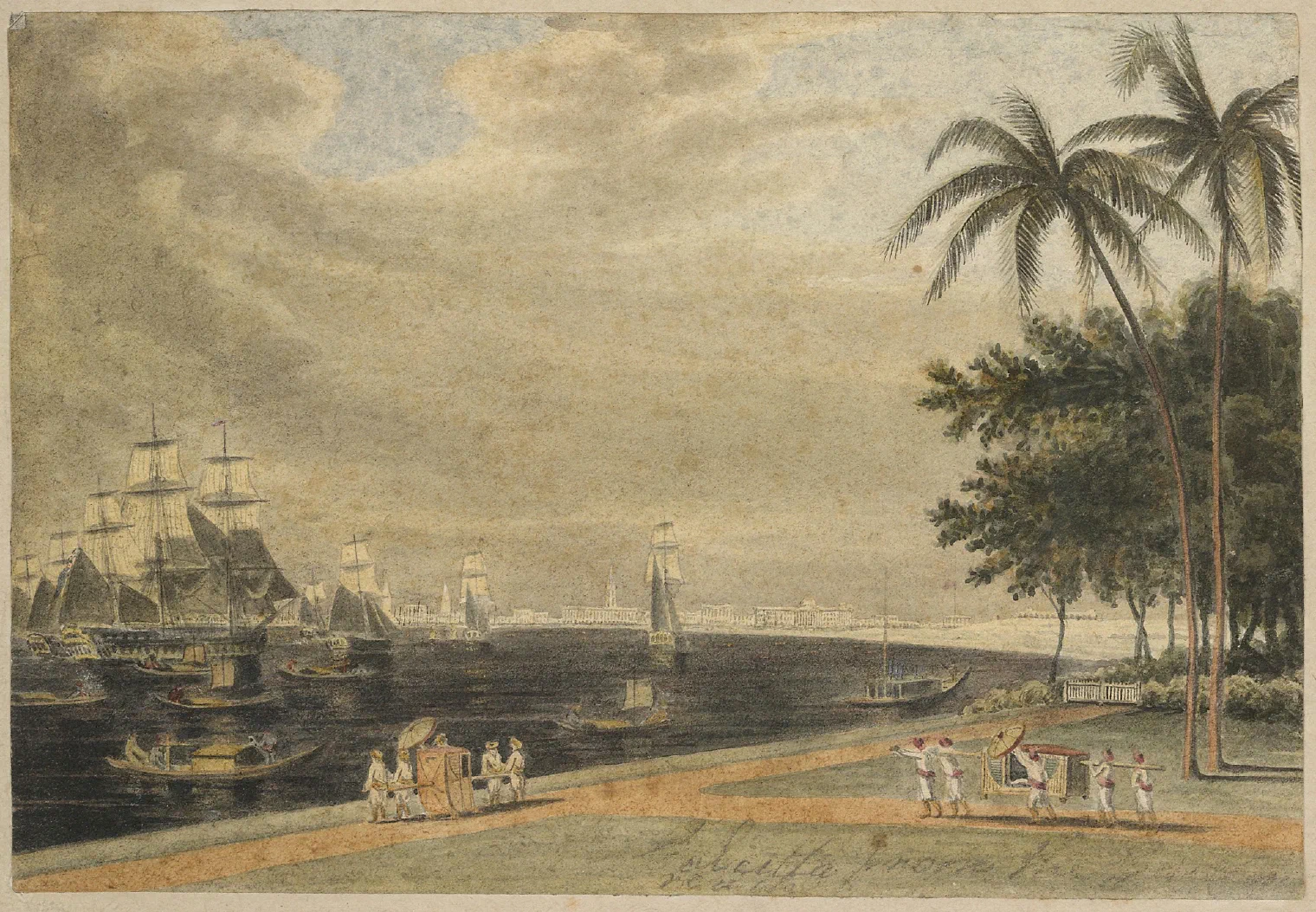
The last stretch below the city was Garden Reach, where the river curves past the gardens and country houses of rich Europeans, and where the picture above was painted. Ahead, along the eastern bank, stood the city.
Calcutta in 1813
How it began
Calcutta was young. In 1690 the East India Company set up a trading post on the Hooghly, and soon after it bought the rights to three villages: Sutanuti, Gobindapur and Kalikata. The town that grew from them gave its name to the whole.
Capital of British India
By 1813 Calcutta was the capital of the Bengal Presidency and the seat of the Governor-General, who ruled all the Company’s territories in India. (A new one, Lord Moira, arrived in October 1813.) Beside the river stood the great star-shaped Fort William, rebuilt after 1757 and finished in 1781, and in front of it the open ground of the Maidan. Facing the Maidan along Chowringhee, where Mr. Harcourt lives in the book, rose the classical mansions that earned Calcutta its nickname, the City of Palaces.
Nobody knew how many people lived there. An official count in 1822 found about 200,000 within the city’s limits, but that left out the suburbs and the thousands who came in every day to work. Other estimates of the time ran far higher.
The Indian city
The Europeans’ Calcutta was the smaller part. North of it lay the much larger Indian city, home to merchants, bankers, craftsmen, servants and labourers from all over Bengal and beyond. Two places from the book:
- Burrabazar, the “great market”, the commercial heart of Indian Calcutta. Its merchant families dealt in cloth from Dhaka, Murshidabad and Cossimbazar, in gold, and in goods of every kind. Bingley soon discovers there that “very little in Calcutta was obtained directly. Every article appeared to pass through three or four hands before reaching the person who required it.”
- Chitpur, to the north, one of the oldest parts of the city, along Chitpur Road, one of its oldest roads. It was full of craftsmen’s workshops, including the woodworkers Bingley goes looking for.
The Armenians
Calcutta’s Armenian merchants were there before the English. Their church, the Holy Nazareth, was rebuilt in brick in 1724 near Burrabazar, and its churchyard holds a gravestone dated 1630, the oldest Christian grave in the city. Armenian merchants traded across Asia, from Persia to the Philippines, and many acted as agents and go-betweens for European newcomers. In the book, Bingley is introduced to one, “Agha Petros, an agent of Armenian descent”, on the morning he first goes to buy indigo.
The ghats
Along the river ran the ghats: flights of steps down to the water, where people bathed and prayed, and where boats loaded and unloaded. Ships anchored in the river, so cargo came ashore in lighters (small barges) and was carried up the steps. In the book, Harcourt tells Bingley that “the ghats will teach you more than Burrabazar.”
Getting about
A newly arrived gentleman went everywhere in a palanquin: a curtained box with a long pole at each end, carried by four or more bearers. Europeans in India took to them because they kept off the sun and the dust, and even junior clerks could afford one. Bingley, on his first morning, is not sure what to make of it:
Bingley, who had not been carried upon another man’s shoulders since he had been old enough to walk upon his own feet, could not decide whether he was travelling as a gentleman of consequence or merely a very large child.
The end of the road
After eight months at sea, arrival is something of an anticlimax in the book. Bingley has no great view to admire, only a low green shore, a crowded river, and a great deal to learn:
He turned at last from the river.
Calcutta did not invite him. It required him.
What he came to buy, and what Calcutta had to sell, is the next part of the series.
By Trade and by Trust is Volume Two of By Patience and by Paper. You can find it here.
Next in The Road East: Pepper, Cloth and Indigo, on what Britain bought from India, and what it sold there.
Sources and further reading
- Thomas Williamson, The East India Vade-Mecum, vol. 1 (London, 1810). The source of the quotations from Williamson in this post. Project Gutenberg.
- J. B. Gilchrist, The General East India Guide and Vade Mecum (1825), quoting Thomas Williamson’s East India Vade-Mecum (1810): section 14 on Madras and the masula boats, and section 15 on the voyage to Bengal and the pilots. Edited online by Frances W. Pritchett, Columbia University.
- Families in British India Society, “Bengal Pilot Service”, FIBIS Wiki.
- Wikipedia, for quick overviews: History of Kolkata, Hooghly River, Fort William, India, Burrabazar, Armenian Church of the Holy Nazareth, Masula boat, Palanquin, Garden Reach, Sagar Island.
Comments
No account needed. Give a name, or leave it blank to post as Anonymous. Comments appear once the author has read and approved them.
Loading comments…