“I May Trade in My Own Name?”: The East India Company and the Charter Act of 1813
What the East India Company was, and why an Act of 1813 changed everything for a man like Charles Bingley.
In By Trade and by Trust, the second book of By Patience and by Paper, Charles Bingley arrives in Calcutta with a modest plan: find merchants who will hire his ship to carry their goods back to England. Then Mr. Harcourt, the man he has come to see, asks whether he has heard of the Charter Act, and takes him into his study:
“You would have me understand,” cried Bingley, his surprise too great to conceal, “that I may trade in my own name?”
“Indeed,” replied Mr. Harcourt.
“And I am no longer obliged to act through the Company?” Bingley persisted.
“You are not,” said Mr. Harcourt, “provided you avoid those articles still reserved to the Company. Tea, and such articles as are connected with the China trade, remain prohibited to private trade.”
A reader today might wonder why an Englishman ever needed anyone’s leave to buy and sell. Who was “the Company”, and why did it get to decide?
This is the first part of The Road East, a series on India, Britain and China in the years of the books. Before we set sail, here is the business that stood behind every ship going east, as plainly as I can put it.

First, what was the East India Company?
It began as a group of London merchants. On 31 December 1600, Queen Elizabeth I granted a charter to “the Governor and Company of Merchants of London trading into the East Indies”: over two hundred men who pooled their money to send ships to Asia for pepper and spices.
The charter gave them something very valuable: a monopoly. No other English subject could trade anywhere east of the Cape of Good Hope without the Company’s permission. A merchant who tried was an “interloper”, and could lose his ship and his cargo.
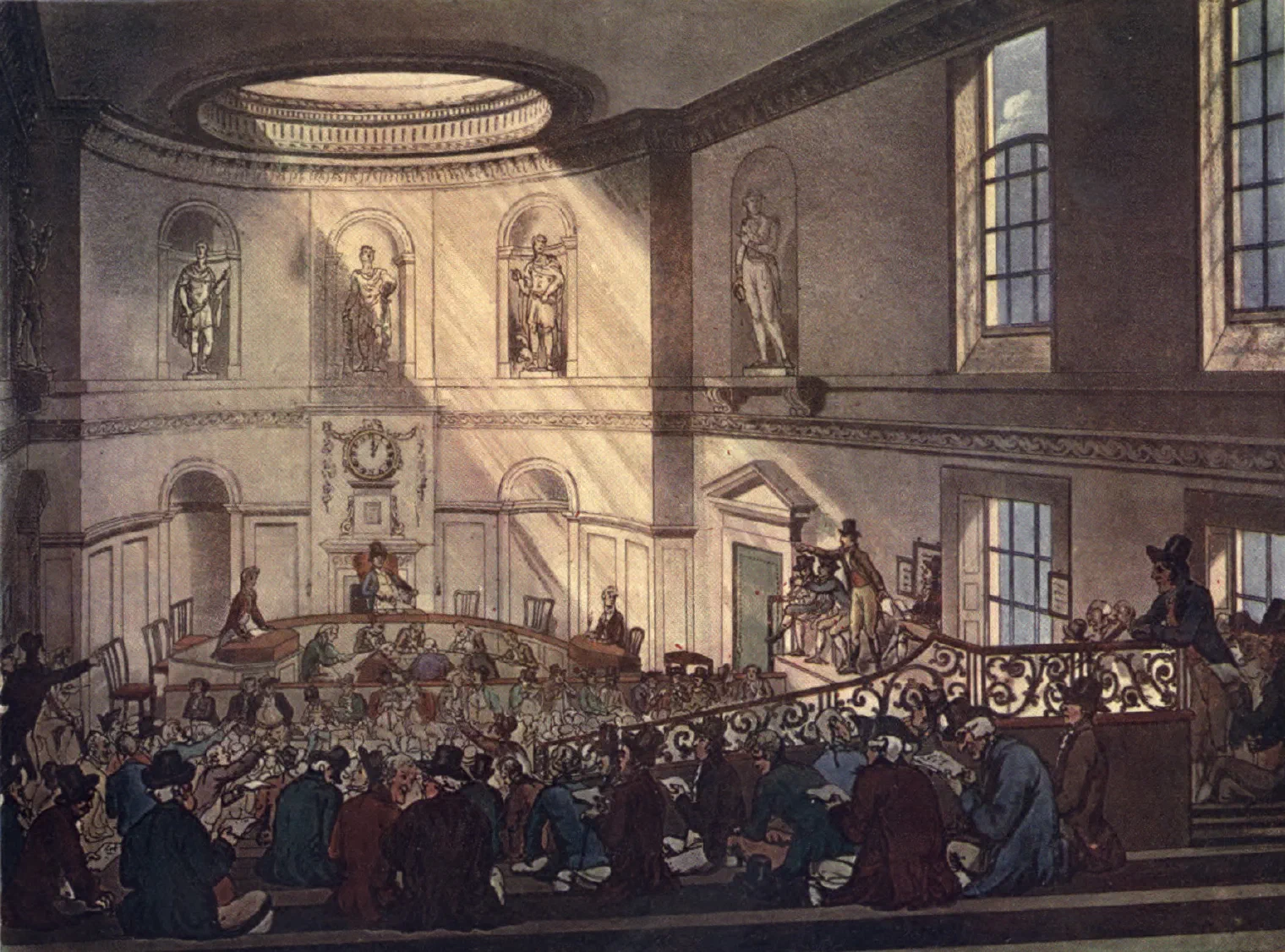
By the time of the books, the Company was run from East India House, a grand building in Leadenhall Street in the City of London. It was owned by its shareholders, called “proprietors”, who elected twenty-four Directors to manage it. Its ships brought home tea, silk, cotton cloth, indigo and spices, and it sold them at auction in the sale room in the picture above.
From traders to rulers
For its first hundred and fifty years the Company was mainly a trading business. It built warehouses and forts on the coast of India to protect them: at Madras from 1639, at Bombay from the 1660s, and at Calcutta from 1690.
Then it became something else. In 1757 Robert Clive, at the head of the Company’s army, defeated the Nawab of Bengal at the Battle of Plassey. In 1765 the Mughal emperor, Shah Alam II, granted the Company the diwani of Bengal, Bihar and Orissa: the right to collect their taxes.
So a company of London merchants found itself governing millions of people. By the 1810s it had its own army, its own courts and its own tax collectors, and ruled from three centres called presidencies: Bengal (with its capital at Calcutta), Madras and Bombay.
Parliament did not like a private company holding that much power. It stepped in twice:
- The Regulating Act of 1773 put a Governor-General in charge at Calcutta.
- Pitt’s India Act of 1784 set up the Board of Control, a government board in London that oversaw how the Company ruled.
From then on the Company still ran its own affairs, but a minister looked over its shoulder.
A monopoly with an end date
The Company’s monopoly was never granted for ever. Parliament renewed it for a fixed number of years at a time, usually in return for money, and each renewal was a fight.
The last renewal before the books came in 1793, and it was for twenty years. The Company kept almost all of its monopoly then. Merchants in Liverpool and manufacturers in Manchester had been pressing to open the trade, and all they got was a small concession: the Company had to set aside 3,000 tons of space a year in its ships for other men’s goods (Bogart).
So everyone knew that the next fight would come in 1813. As Mr. Harcourt says, the Charter Act “has been much spoken of for some years.”
Until then, a man like Bingley had two choices. He could hire his ship to the Company, or he could carry goods for someone else who had its leave. That is why he calls himself, before Harcourt opens his eyes, “a mere owner, letting out his vessel for hire, and a carrier of timber for the East India Company”.
Why 1813 was different
Several things came together at once.
- War had closed Britain’s markets. From 1806, Napoleon’s Continental System shut British goods out of much of Europe, and in 1812 Britain went to war with the United States too. Manufacturers needed new customers, and India had millions of them.
- The ports outside London wanted a share. Under the monopoly, everything came and went through London. Merchants in Liverpool, Bristol and Glasgow wanted ships to sail from their own docks. About 130 petitions reached Parliament asking for the trade to be opened, and Liverpool led them. London, naturally, backed the Company.
- Ministers had changed their minds. The men who ran the Board of Control, first Lord Melville and then Lord Buckinghamshire, came to believe that competition would do the India trade more good than a monopoly.
- The Company was weaker in Parliament. The Prime Minister, Spencer Perceval, was assassinated in May 1812, and after the election that followed, the Company had far fewer friends in the government. One of its Directors admitted, “I had no idea we stood on such weak ground.”
(The economic historian Dan Bogart sets all this out in his paper on the end of the Company’s monopoly, drawing on C. H. Philips’s history of the Company.)
But the government would only go so far. China and tea stayed with the Company. Tea was the Company’s most valuable trade, the duty on it brought the government a great deal of money, and the trade at Canton was a delicate business that ministers did not want to disturb. That is a story for the last part of this series.
What the Act said
The Act’s full name is a mouthful, and this is only the start of it: “An Act for continuing in the East India Company, for a further Term, the Possession of the British Territories in India, together with certain exclusive Privileges”. Most people called it the Charter Act. In plain words:
- The Company kept India. It would go on governing its territories for at least another twenty years.
- The India trade was opened. After 10 April 1814, any British subject could trade between the United Kingdom and the ports within the Company’s limits, except China.
- Tea stayed with the Company. Nobody else could trade in tea without its licence.
- Only large ships. A private ship had to be at least 350 tons to trade within the Company’s limits. Small vessels were kept out.
- Approved ports only. Private ships had to sail from, and return to, ports in the United Kingdom approved by the government. That let Liverpool, Bristol and Glasgow in alongside London.
- Licences, but easier ones. A ship still needed a licence from the Company’s Directors to go to India. For the main settlements, such as Calcutta, Madras and Bombay, the Directors had to grant one as a matter of course. For anywhere else, they could refuse, but the Board of Control could overrule them.
Those last rules explain Harcourt’s warning that “the rules are not yet fully understood, nor the procedures settled”. Freedom to trade came with paperwork.
The Act did other things too. It set up a Bishop of Calcutta, with three archdeacons, paid by the Company: £5,000 a year for the bishop. It set aside a lakh of rupees (100,000) a year for schools and learning in India. And it stated plainly that the Crown, not the Company, was sovereign over British India.
You can read a summary of the whole Act, clause by clause, made at the time: it is printed in the appendix to the Final Debates of the Company’s proprietors (1813).
Passed in July, in force in April
The House of Lords passed the bill on the evening of 20 July 1813. The next day, Wednesday 21 July, the Company’s proprietors met at East India House to decide whether to accept it. They did, and with some relief: the bill had been softened on its way through Parliament. As Sir Hugh Inglis, one of the Directors, put it, “the public were allowed a participation in the India trade, but the Company still had the exclusive trade in tea.”
The Act received the royal assent on 21 July 1813. That is the date on the copy kept in the Company’s own archive, now in the British Library (India Office Records, IOR/A/2/17). Some modern references, Wikipedia among them, give 22 July instead.
But passing the Act did not open the trade that day. The new rules were written to start the following spring. In the words of the summary printed that year, British subjects could trade “after 10th April, 1814”, and any other part of the Act “for which no particular time is appointed” was to begin on that same day, 10 April 1814.
Meanwhile, the news had to travel. In the book, Bingley’s partner Thompson writes from Newcastle in July 1813:
“Parliament, in a rare fit of good sense and most inconvenient timing, has opened the Indian trade. The Charter Act has passed, and those responsible had the extraordinary discourtesy to do so three months after your departure.”
His letter goes on to urge Bingley to buy “pepper, indigo, silk, spices, cotton, tea, timber, dyes”, anything that can be loaded aboard a ship. It is lucky Harcourt got to Bingley first. Tea was the one thing on that list he still could not touch.
A letter from England to Calcutta took months, by whichever ship would carry it. In the book, Harcourt hears of the Act about four months after it passed, which is about right. How the post reached India at all is a story for another day.
A small confession
Strictly speaking, Mr. Harcourt is too early.
The scene in his study takes place in December 1813, when the Act was “scarcely five months” old. Bingley could not lawfully have traded in his own name until 10 April 1814. The book owns up to this in a footnote:
“Mr. Harcourt is four months ahead of Parliament. The fault is neither his nor history’s. Call it the Freedom of fiction.”
Four months is a small liberty, and the rest of the history holds. The Act did pass in July 1813, the news did take months to reach Calcutta, and many merchants did hang back, unsure of the rules, just as Harcourt says.
What happened next
The 1813 Act was the beginning of the end of the Company as a business. Here is the whole story in one list:
| Year | What happened |
|---|---|
| 1600 | Elizabeth I grants the charter. The Company’s monopoly begins. |
| 1757 | The Battle of Plassey. The Company becomes a power in Bengal. |
| 1765 | The Mughal emperor grants it the right to collect taxes in Bengal. |
| 1773 | The Regulating Act: a Governor-General at Calcutta. |
| 1784 | Pitt’s India Act: the Board of Control in London. |
| 1793 | The charter renewed for twenty years, with 3,000 tons for others. |
| 1813 | The Charter Act: the India trade opened, from 10 April 1814. |
| 1833 | The next Charter Act: the Company loses China and tea, and stops trading altogether (from 1834). It now only governs. |
| 1857 | The great rising against Company rule across northern India. |
| 1858 | The Government of India Act: the Crown takes over. |
| 1874 | The Company is wound up. |
For the people in the books, though, 1813 was the year that mattered. For two hundred years the road east had belonged to one company. Now, with a licence, a large enough ship and some nerve, a young man from Newcastle could take it in his own name.
By Trade and by Trust is Volume Two of By Patience and by Paper. You can find it here.
Next in The Road East: The Voyage Out, on how a ship got from England to the Cape, and what life was like on board.
Sources and further reading
- Final Debates on the Renewal and Acceptance of the East-India Company’s Charter (London: Black, Parry and Co., 1813). The proprietors’ meetings of 9 to 21 July 1813, with an abstract of the bill, clause by clause, in the appendix. Internet Archive.
- Act 53 George III, c. 155, 21 July 1813, India Office Records IOR/A/2/17, British Library. Catalogue entry (Adam Matthew, East India Company).
- Dan Bogart, “The East Indian Monopoly and the Transition from Limited Access in England, 1600–1813”, in Organizations, Civil Society, and the Roots of Development (NBER and University of Chicago Press, 2017). Working paper version.
- Anthony Webster, “The Political Economy of Trade Liberalization: The East India Company Charter Act of 1813”, Economic History Review 43.3 (1990), pp. 404–419. (Subscription needed.)
- Anthony Webster, The Twilight of the East India Company: The Evolution of Anglo-Asian Commerce and Politics, 1790–1860 (Boydell Press, 2009).
- C. H. Philips, The East India Company, 1784–1834 (Manchester University Press, 1940; reprinted 1961).
- Wikipedia, for quick overviews: East India Company, Charter Act 1813, Charter Act 1793, Regulating Act 1773, East India Company Act 1784, Battle of Plassey, Treaty of Allahabad, Continental System, Saint Helena Act 1833, Government of India Act 1858, East India House.
Comments
No account needed. Give a name, or leave it blank to post as Anonymous. Comments appear once the author has read and approved them.
Loading comments…