“Entirely Without Shame”: The Cape of Good Hope in 1813
Table Mountain, the seals, and why nearly every ship bound for India stopped at the tip of Africa.
In By Trade and by Trust, Charles Bingley reaches Cape Town after a hundred and fifteen days at sea and writes at once to Darcy. He has important news:
I must begin with the matter of greatest importance, which is that the harbour at Cape Town appears to be entirely occupied by fur seals. I was not informed of this before I arrived. They are large, numerous, and entirely without shame, and regard the landing place as their own property, a claim which no one here seems inclined to dispute.
The seals are real, if not quite as many as Bingley claims, and so is the rest of what he finds. This is the third part of The Road East. In Part 2 we sailed from England to the tip of Africa. Now we go ashore.
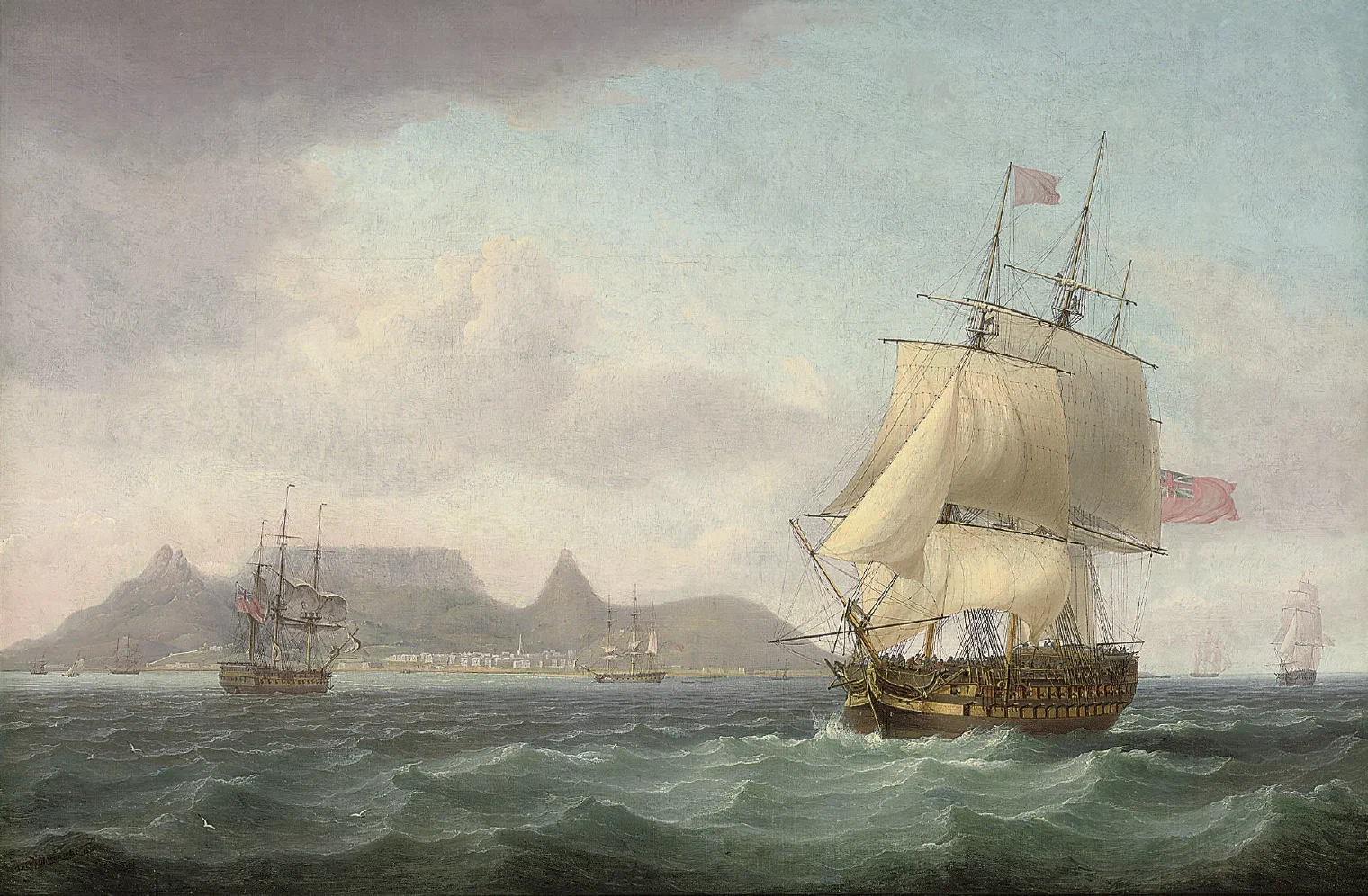

Why the ships called there
The Cape sits about halfway between England and India. After three or four months at sea, a ship needed four things, and the Cape had all of them:
- Fresh water, running down from Table Mountain.
- Fresh food: meat, fruit and vegetables, the cure for scurvy.
- Repairs, after the storms of the South Atlantic and before the even worse ones ahead.
- News and letters, left by ships coming the other way.
In the book, the Cape agent Van der Meer has kept a record of every ship that called that season, and Bingley sums it up for Darcy:
There is not a single ship on the eastward passage that does not stop here. They all require provisions and fresh water, and a full third require further work.
That was the whole point of the place. Thomas Williamson, who knew it well, was blunt: as a colony, he wrote in 1810, the Cape “cannot be said, at present, to be valuable in any respect, except as an asylum for shipping, homeward or outward bound.”
Who ruled the Cape?
It had changed hands three times in twenty years.
| Year | What happened |
|---|---|
| 1652 | The Dutch East India Company (the VOC) sets up a station at Table Bay to feed and water its ships, under Jan van Riebeeck. |
| 1795 | Britain occupies the Cape, to keep it out of French hands while France controls the Netherlands. |
| 1803 | The Cape is handed back to the Dutch under the peace of Amiens. |
| 1806 | War again. A British force lands, wins the Battle of Blaauwberg on 8 January, and takes the Cape for the second time. |
| 1814 | The Netherlands formally gives the Cape to Britain. |
So when Bingley lands in July 1813, the Cape is British-run but not yet British by treaty, and Cape Town is still a Dutch town in its houses, its language and its habits. Williamson, never a great admirer of the Dutch, complained that “the inhabitants of Cape Town think of nothing but money-making”. Every visitor noticed the stoep, the raised terrace in front of each house where the owners sat in the evening with their pipes.
Table Mountain
Nothing prepared a newcomer for the mountain. Bingley’s letter:
It rises above the horizon, flat and enormous, as though the land were determined to make its form plainly known.
Table Mountain stands over a thousand metres high, with a top so flat it looks cut with a knife. Two peaks guard it, Devil’s Peak to the east and Lion’s Head to the west, and they can all be seen in the picture above. When the south-east wind blows, a sheet of white cloud pours over the flat top and down the face: the famous “tablecloth”.
That same south-easter, the “Cape Doctor”, was said to blow away the town’s dust and disease. Williamson noticed something less pleasant about it: it drove “the small gravel against one’s face with such force as to give very acute pain.”
The seals
The Cape fur seal lives all along the coast of south-western Africa, in colonies of thousands. A grown male is over two metres long and can weigh two hundred kilograms or more. The island in Table Bay that sailors used as a lookout and a prison is called Robben Island: robben is the Dutch word for seals.
By 1813, though, Table Bay had far fewer seals than it once did. Sailors and settlers had clubbed them for their skins and oil since before the Dutch arrived. When Joseph Banks passed by in 1771, on his way home with Captain Cook, he described Robben Island as “named after the Seals that formerly usd to frequent it”. Williamson, who wrote pages and pages about the Cape, does not mention them at all.
So one seal behind a coil of rope is quite possible: seals still haul themselves out on the quays of Cape Town today. A harbour “entirely occupied” by them is Bingley enjoying himself. To a gentleman like Bingley, who had never seen one, even one was worth a letter.
Without shame
There may be more in Bingley’s seals than seals. Read his description again: “large, numerous, and entirely without shame, and regard the landing place as their own property, a claim which no one here seems inclined to dispute.”
Readers of Pride and Prejudice have met someone like that. Caroline Bingley spent the whole of that novel treating Mr. Darcy, and Pemberley with him, as hers by right, and no one, least of all her brother, was inclined to dispute it. And at the end of this same letter, Bingley adds:
I shall write to Louisa and Caroline before we sail. I have not yet determined what I wish to say to Caroline, but I have promised myself that I will write, and I shall keep that promise.
Bingley never says that he had his sister in mind. But he is writing to Darcy, the one man who would see the point.
Summer and winter
There was one catch. Table Bay was not safe all year. It lies open to the north-west, and in the southern winter, roughly May to August, north-westerly gales could drive ships onto the shore. In winter, many ships went instead to Simon’s Bay, on the sheltered side of the peninsula, about twenty-five miles from Cape Town.
Williamson advised that it was “very desirable on every account” to arrive in summer, when a ship could anchor in Table Bay “about half a mile distant from the wharf”. He added that losses in winter were rarer than people feared, because ships that did use the bay kept their stay short.
Constance arrives at the end of July, in the middle of the winter, and stays about ten days. Askew’s refusal to sail until the fore-topsail is properly mended, before the Indian Ocean, is only good seamanship.
What a traveller found
For passengers, the Cape meant a few precious days on land. Williamson gives the prices: lodgings with a family cost “from three to four rix-dollars for each lady or gentleman” a day, all found. A careful single gentleman could hardly live, with washing and horse hire, on less than thirty shillings a day.
There was plenty to do:
- Walk in the Company’s Garden, the old Dutch kitchen garden in the middle of the town, with its long avenue of oaks, crowded on Sunday evenings.
- Ride out to Constantia, whose sweet wine was famous across Europe. Williamson warns newcomers to drink port instead, until they are used to the local wine.
- See the flowers. Even Williamson, who liked very little at the Cape, admired the wild heaths.
- Eat fresh food again, after months of salt meat. That alone made the stop worth it.
The people who did the work
The Cape was not a comfortable place for everyone. In 1807 the colony counted about 73,000 people. Roughly 29,000 of them were enslaved, brought from Madagascar, Mozambique, India and the East Indies. About 17,000 were Khoekhoe, the people who had lived at the Cape long before the Dutch arrived, many of them now working on farms they did not own.
When a ship took on water, meat and wine, much of the labour behind it was theirs. Britain banned the slave trade in 1807, so no new enslaved people could be brought in after that. But slavery itself was not abolished at the Cape until 1834, and the people freed then were held as “apprentices” until 1838.
Onward
A ship rarely stayed long: a week or two to take on water and food, make repairs and send letters home. Then came the Indian Ocean, which had storms of its own.
Bingley leaves the Cape in a better frame of mind than he arrived. To Darcy he admits that he has found “the satisfaction of arriving somewhere and having work of my own”, and ends:
The Indian Ocean is still ahead of me, and Calcutta after that. I confess I am more ready for both than I was a month ago.
By Trade and by Trust is Volume Two of By Patience and by Paper. You can find it here.
Next in The Road East: Up the Hooghly to Calcutta, on the surf at Madras, the river pilots, and the city at the end of the road.
Sources and further reading
- Thomas Williamson, The East India Vade-Mecum, vol. 1 (London, 1810). The source of the quotations from Williamson in this post. Project Gutenberg.
- J. B. Gilchrist, The General East India Guide and Vade Mecum (1825), section 12, on the Cape. A later edition of Williamson’s book, edited online by Frances W. Pritchett, Columbia University.
- Joseph Banks, Endeavour journal, vol. 2, page 679, on Robben Island in 1771. State Library of New South Wales.
- Wikipedia, for quick overviews: Cape Colony (including the 1807 count of its people), Dutch Cape Colony, Battle of Blaauwberg, Anglo-Dutch Treaty of 1814, Table Mountain, Brown fur seal, Robben Island, Simon’s Town, Company’s Garden, Constantia wine, Slavery in South Africa.
Comments
No account needed. Give a name, or leave it blank to post as Anonymous. Comments appear once the author has read and approved them.
Loading comments…