“Prohibited to Private Trade”: Tea, Silver and Canton
The trade the East India Company kept for itself, and the silver, and the opium, that paid for it.
On his first morning in Calcutta, in By Trade and by Trust, Charles Bingley calls on Mr. Harcourt, explains his business, and is met with an unexpected question:
“You are plain-spoken, sir,” said he. “Have you yet tasted real Indian tea?”
Bingley, surprised by the question, smiled before replying. “I have this morning, at a shop near the corner.”
“Ah,” said Mr. Harcourt, “do not let that prejudice you against genuine Indian tea.”
Within the hour, Harcourt is telling Bingley that he may now trade in his own name, with one great exception: “Tea, and such articles as are connected with the China trade, remain prohibited to private trade.”
This is the sixth and last part of The Road East. In Part 5 we went to market in Calcutta. Now we follow the one trade that Bingley could not touch, to the far end of the road: Canton.

A nation of tea drinkers
By 1813, Britain drank tea as it drinks it now: every class, every day. Nearly all of it came from China, and all of it legally came through one company. The East India Company bought it in China, shipped it home, and sold it at auction at East India House in London, in the sale room pictured in Part 1.
Tea was also one of the government’s best sources of money. In 1784 Pitt’s Commutation Act cut the tax on tea from 119 per cent to 12½ per cent, to kill off smuggling. It worked, and tea drinking soared. Then came the long wars with France, and the duty crept back up: to 60 per cent on the cheaper teas by 1803, and 90 per cent by 1806. A writer in Dickens’s magazine Household Words looked back on it in 1850: the duty had been “raised from 12½ per cent. to 96 per cent.”
So when Parliament opened the India trade in 1813, ministers were not ready to risk the tea trade. The Company kept its monopoly of tea, and of all trade with China, for another twenty years.
Only at Canton
The Company could not simply buy tea wherever it liked. The Chinese Empire set the rules, and they were strict.
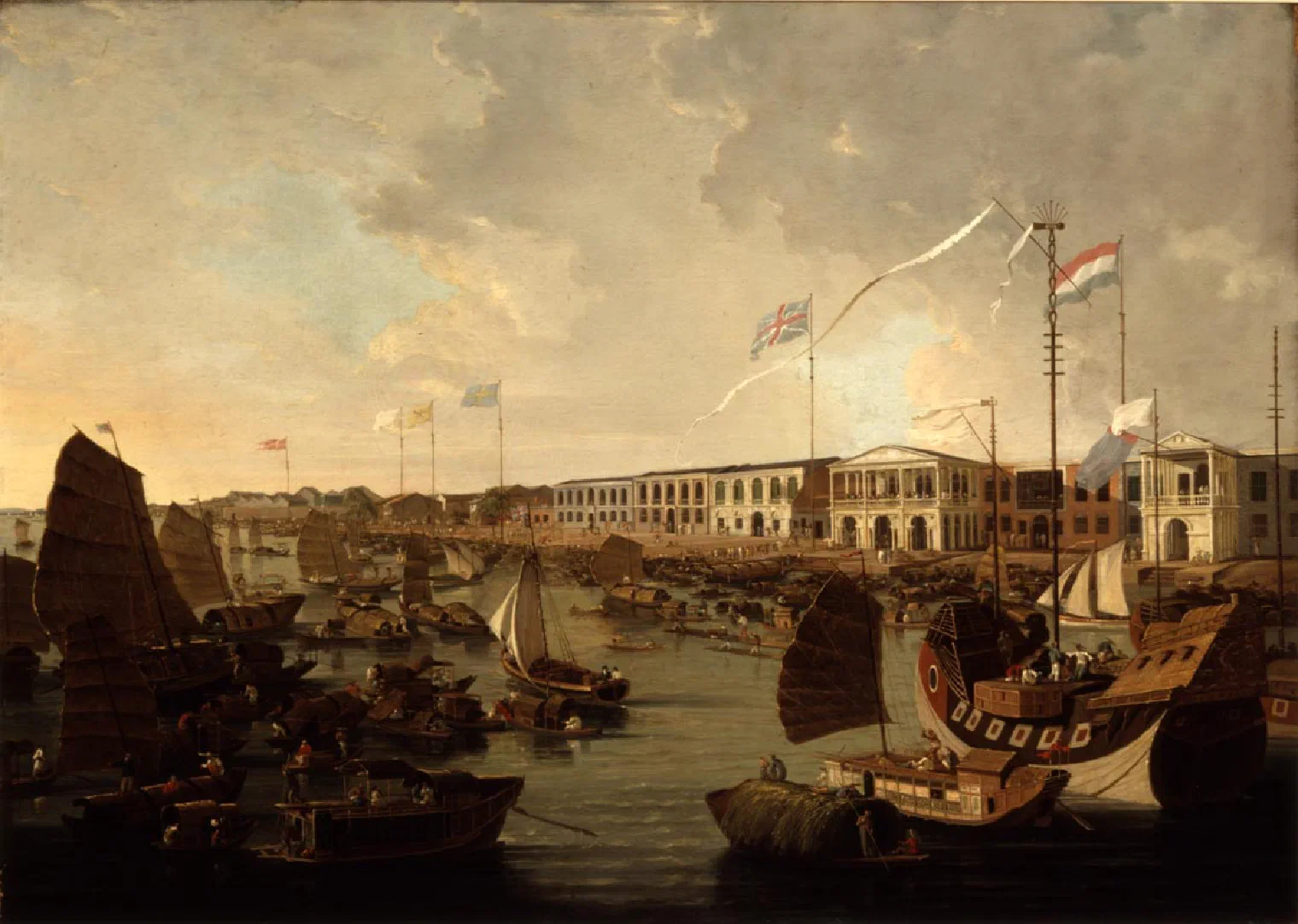
From 1757, the Qianlong Emperor allowed Western merchants to trade at only one port: Canton (now Guangzhou), far in the south. This was the Canton System, and it lasted for eighty-five years.
- Only licensed Chinese merchants could deal with the foreigners. These were the Hong merchants, who from 1760 formed a guild called the Cohong. Every chest of tea was bought through them.
- A customs official, known to the Europeans as the Hoppo, collected the Emperor’s duties.
- The foreigners lived and worked in the “factories”, a row of buildings on the riverbank outside the city walls, in the picture above. (A “factory” here meant a trading house, not a mill.) Each nation flew its flag in front of its own.
- Trade had a season. Ships came in on the south-west monsoon in late summer and left with the north-east monsoon in winter. Out of season, the foreign merchants were expected to leave Canton and wait at Macau, down the river.
The Company’s men at Canton were called supercargoes, and its senior ones formed the Select Committee, which ran the whole of the Company’s China trade. They were some of the best-paid men in the Company’s service.
What came home
The tea itself came in many grades, with names every grocer in England knew:
- Bohea: the cheapest black tea, drunk by the poor.
- Congou and Souchong: better black teas.
- Hyson: the finest green tea, for those who could afford it.
Alongside the tea came silk, porcelain (still called “china” in English), and nankeen, a tough yellow cotton cloth that made fashionable trousers.
The silver problem
There was one great difficulty with the China trade. China wanted very little that Britain made. Chinese officials and merchants had no great need of English woollens or ironware. They would take one thing gladly: silver.
So for most of the eighteenth century, the Company’s ships sailed to Canton carrying chests of silver coin, mostly Spanish dollars, and came home with tea. Year after year, silver flowed out of Europe into China. It was a drain no government liked.
Opium
The answer the British found was opium, and it is the darkest part of this story.
After the Company became the ruler of Bengal, it took control of the opium grown there. Indian farmers grew the poppies; the Company bought the opium and sold it at public auctions in Calcutta. The Company did not carry it to China itself, because the Chinese Emperor had banned opium. Instead, it sold it to private merchants, the “country traders”, many of them British, Parsi or Armenian, who smuggled it into China.
Then the money went round in a circle:
- The country traders sold their opium on the China coast, for silver.
- They paid the silver into the Company’s treasury at Canton, in exchange for bills of exchange they could cash in London or Calcutta.
- The Company used the silver to buy tea.
- The tea went to London and was sold at East India House.
The silver that had once flowed into China now began to flow back out. The cost was paid by millions of Chinese opium users, and by a Chinese government that grew more and more determined to stop it.
Why Bingley could not touch it
All this explains Harcourt’s warning, and Thompson’s mistake. In Thompson’s letter from Newcastle, among the things Bingley is told to buy, is “tea”. But a private merchant in 1813 could not carry tea to England: it belonged to the Company. Nor could he trade with China, except as one of the licensed country traders working inside the Company’s system.
What was in Harcourt’s teapot?
There is one more thing to say about tea, because Harcourt invites it. In 1813, India did not yet grow tea for sale.
Tea plants did grow wild in the hills of Assam, in the far north-east, where the Singpho people brewed their leaves. But the British did not learn of them until 1823, when a Scottish trader, Robert Bruce, was shown the plants with the help of the Assamese nobleman Maniram Dewan and a Singpho chief. It took years more to prove that the plant was real tea, and to grow it. The first Assam tea was sent to London in 1838 and sold at auction in January 1839. Darjeeling followed in the 1850s.
So the tea Bingley drank in Calcutta in 1813, at the shop and at Harcourt’s table, would almost certainly have come from China. Perhaps Harcourt’s “genuine Indian tea” was China leaf, made the way Calcutta liked it. Either way, he was a quarter of a century ahead of the tea gardens.
How it ended
| Year | What happened |
|---|---|
| 1813 | The Charter Act: the India trade opens; the Company keeps tea and China. |
| 1816 | A British embassy under Lord Amherst goes to Peking to ask for better terms. It is sent away without seeing the Emperor. |
| 1833 | The next Charter Act ends the Company’s China monopoly, from 1834. It stops trading altogether. |
| 1839 | The Chinese commissioner Lin Zexu seizes and destroys more than 20,000 chests of opium at Canton. |
| 1839–42 | The First Opium War. |
| 1842 | The Treaty of Nanking: Hong Kong is given to Britain, five ports are opened to foreign trade, and the Canton System ends. |
The end of the road
That is the whole road east, as Bingley would have known it in 1813: from the sale room at East India House, down the long curve of the Atlantic, past the seals at the Cape, through the surf at Madras and up the Hooghly to Calcutta, and on, for the Company alone, to the tea warehouses of Canton.
For Bingley, in this book, the road ends at Calcutta. What he makes of it there is the story.
By Trade and by Trust is Volume Two of By Patience and by Paper. You can find it here. And if you missed the start of the series, it begins with the Company and its Charter.
Sources and further reading
- Household Words, vol. 1 (1850), page 255, on the history of the tea duty. (Dickens Journals Online.)
- Dan Bogart, “The East Indian Monopoly and the Transition from Limited Access in England, 1600–1813” (working paper), on why the China trade stayed with the Company.
- Anthony Webster, The Twilight of the East India Company: The Evolution of Anglo-Asian Commerce and Politics, 1790–1860 (Boydell Press, 2009).
- Michael Greenberg, British Trade and the Opening of China, 1800–42 (Cambridge University Press, 1951). The classic account of the country trade, opium and silver.
- Hosea Ballou Morse, The Chronicles of the East India Company Trading to China, 1635–1834 (Oxford, 1926–29). The Company’s own year-by-year record at Canton.
- Wikipedia, for quick overviews: Canton System, Thirteen Factories, Cohong, Commutation Act 1784, History of opium in China, Amherst embassy, Assam tea, Maniram Dewan, First Opium War, Treaty of Nanking.
Comments
No account needed. Give a name, or leave it blank to post as Anonymous. Comments appear once the author has read and approved them.
Loading comments…