“Nine Vessels Upon the Stocks”: Shipbuilding at Newcastle in 1812
Coal, oak, Baltic timber and Napoleon's blockade: the trade Charles Bingley chose for himself.
In By Fable and by Fact, Charles Bingley leaves Netherfield behind and goes north. “To Newcastle,” he tells his sisters. “I mean to enter into the shipbuilding trade, a pursuit entirely new to us, and wholly distinct from any enterprise of our father’s.” Months later, he is telling Darcy how the business goes:
“Have you heard of Baltic timber?” Bingley returned.
“I have,” Darcy replied. “Timber brought from Sweden and her neighbouring countries, used for hulls, masts, and spars.”
Bingley laughed. “Why did I trouble to ask? I might have known you would already be acquainted with it. You have read everything that may be read. But, to the point. At present, there are no fewer than nine vessels upon the stocks …”
This post is about the trade Bingley chose: why ships were built on the Tyne, what went into them, why a timber merchant in 1812 talked about Napoleon as much as about trees, and what happened on the day a ship was finally launched.

Why Newcastle? Coal
The short answer is coal. The Tyne Built Ships history of the river puts it in one line: “The driving force for shipbuilding was coal.”
London burned coal from the North East, and almost all of it came by sea. In 1795, 4,395 cargoes of coal were delivered to London; by 1824 it was about 7,000. The ships that carried it were colliers: tubby, strong, plain sailing ships, most of them rigged as brigs by Bingley’s day, that ran down the east coast to the Thames, unloaded, and came back for more. The Tyne alone shipped about 1,425,000 tons of coal in 1800.
Coal could not go straight from the pit into a collier. The river was shallow, full of sandbanks and sharp bends, so the coal went down to the ships in keels, broad wooden barges worked by the famous keelmen of Tyneside.
So the river was full of ships, and ships wear out. Every collier needed repairs, and in time a replacement. That steady demand made the North East one of the great shipbuilding regions of England. It also taught it to build a particular kind of ship: broad, flat-bottomed and strong, built to carry heavy loads and to sit on a beach or a mud bank at low tide without harm. When Captain Cook went looking for a ship to take round the world in 1768, the Navy bought him a Whitby collier, the Earl of Pembroke, and renamed her Endeavour.
The yards on the Tyne
For centuries, only freemen of Newcastle who belonged to the town’s Shipwrights’ Company were allowed to build ships on the Tyne, and no ship was to be built at North or South Shields, at the river’s mouth. The Shields men fought this, “often by force, until about 1720”. Robert Wallis of South Shields is usually named as the builder who broke the rule, though his was probably only the best-known of many such fights.
By 1812, yards stood all along the river:
- Newcastle itself, in a few cramped yards. The river ran between steep banks there, with little room for building.
- St Peter’s, just downstream, where William Rowe built ships from 1756. In 1810 his yard passed to Thomas and William Smith, who went on building there for decades.
- Howdon, further down, where some Newcastle freemen moved to find space.
- North and South Shields, at the mouth, which by then had more yards than Newcastle.
How many? The Tyne Built Ships lists for 1800 name 29 ships launched on the river that year, from at least fifteen different builders, the busiest of them building four or five. A timeline of Tyne shipbuilding gives South Shields alone 12 yards, with 500 ships of over 100,000 tons registered there. (That timeline dates the figure 1809 in one place and 1800 in another, so take the year as roughly right, not exact.)
By 1827 the port of Newcastle owned 862 ships, carrying 186,500 tons and crewed by 8,710 seamen, which the local historian Eneas Mackenzie reckoned at “above one-sixteenth of the whole British shipping”. Around the yards grew every trade a ship needed. Mackenzie lists “many extensive roperies, sail-cloth manufactories, block, mast, and pump makers, boat-builders”, and foundries where “anchors, chains, and almost every article of naval ironmongery” were made.
What “on the stocks” means
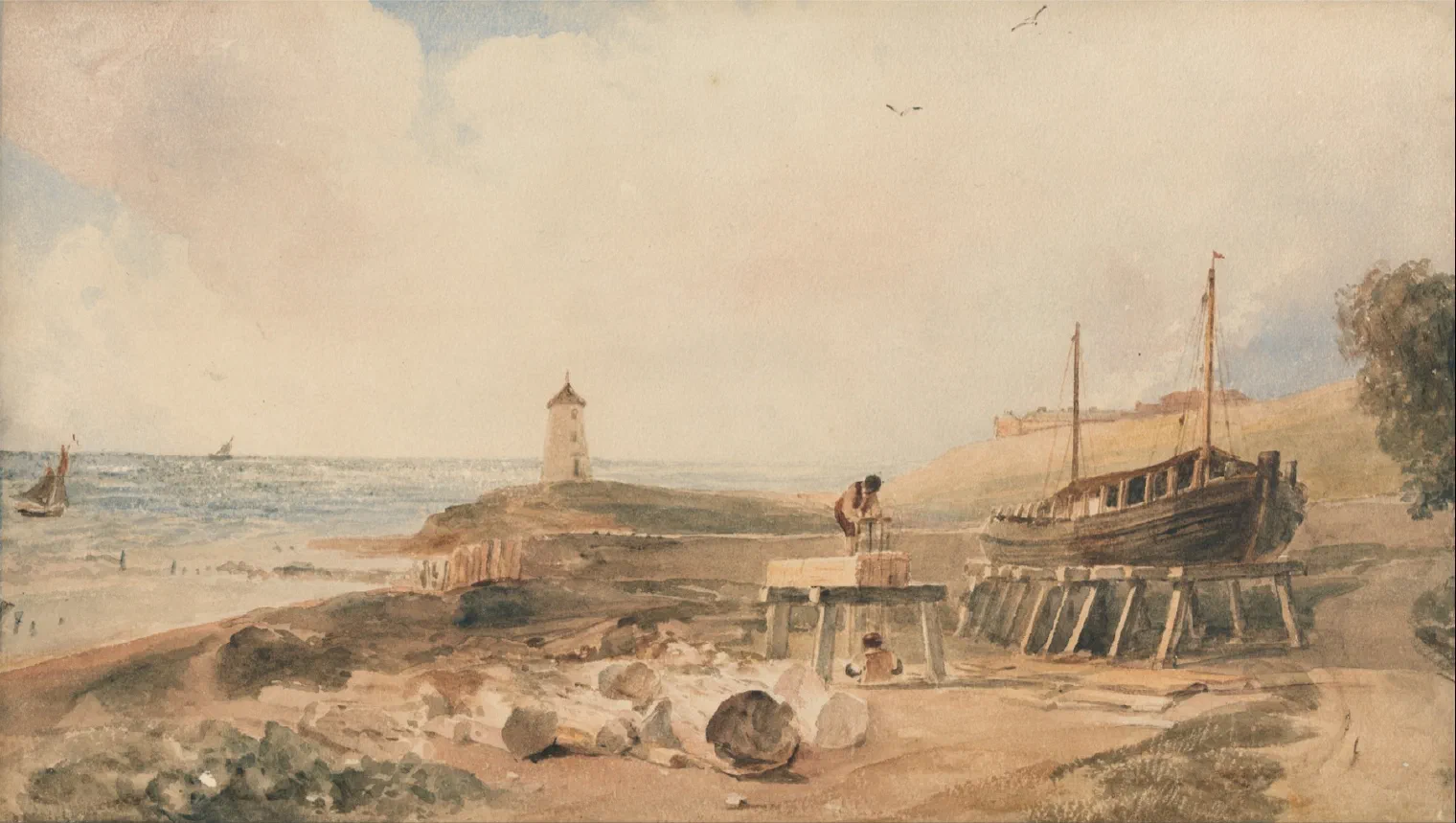
A wooden ship was built out of doors, on dry land, sloping gently down towards the water. First the shipwrights laid down a row of heavy blocks, the stocks, and set the keel on top of them. The ship then grew upward from the keel, frame by frame, until she stood high above the ground on her blocks, like the little vessel in de Wint’s picture.
So when Bingley says “nine vessels upon the stocks”, he means nine ships under construction at once, each at a different stage. That would make Thompson and Bingley a very busy yard. A large Tyne yard of the day might launch four or five ships a year, and the whole of Sunderland, the busiest shipbuilding river on that coast, had 24 yards by 1814.
What a ship was made of
Bingley’s footnote in the book says that Baltic timber “went into nearly everything a shipyard produced”. It did, but not alone.
| Part of the ship | What it was made of | Where it came from |
|---|---|---|
| Frame, stem, sternpost, knees | Oak | England, the best of it; also the Baltic |
| Keel and parts always under water | Elm | England |
| Planking | Oak plank | England and the Baltic (Danzig plank was prized) |
| Decks, and building ashore | Fir and pine “deals” | The Baltic and Norway |
| Masts and spars | Fir (Scots pine) | Riga and Memel above all; Norway; later Canada |
| Rigging and cables | Hemp | Russia and the Baltic |
| Seams and timbers | Pitch and tar | The Baltic; later North America |
| Bolts, nails, anchors | Iron | British foundries |
| Sheathing below the waterline | Copper, or wooden boards | British copper |
| Sails | Canvas (sailcloth) | British and local mills |
Oak
English oak was the heart of a ship. The historian Robert Albion explains that the curved pieces, “compass timber”, came best from oaks grown alone in hedgerows, where they spread and twisted, rather than from straight trees in a wood. A ship’s builder needed bends of every shape for ribs, knees and stem.
Albion gives a handy rule: an ordinary oak of timber size held about a load of timber (fifty cubic feet), and “made nearly a ton of shipping”. A collier of three hundred tons, then, needed something like three hundred oaks.
Masts
Oak was too heavy and too crooked for masts. For those, a builder wanted tall, straight, springy fir, and the best came from the Baltic. “In the shipyards of France and Spain as well as of England,” Albion writes, “Riga masts were preferred above all others for their quality. The shavings could be twisted between the fingers without breaking.” North American white pine was bigger, but softer and less lasting.
Deals
A deal was a sawn plank of pine or fir, two or three inches thick, used for decks and for a thousand jobs ashore. Deals came by the shipload from Norway and the Baltic. Mackenzie’s list of what Newcastle imported reads like a shipyard’s shopping list: “staves, timber, masts, plank, tar, iron, deals, corn, sugar, hemp, flax”.
Copper
A wooden hull in warm seas was eaten by shipworm and fouled by weed. The Royal Navy began coppering the bottoms of its whole fleet in 1778. Merchant owners followed more slowly, because copper was dear: by 1786 only about 3 per cent of British merchant ships were coppered, and by 1816 about 18 per cent, mostly ships bound for the tropics. A collier working the cold North Sea usually made do with cheaper wooden sheathing that could be replaced. A ship meant for India, as Bingley’s later ships were, would want copper.
Napoleon closes the Baltic
For a shipbuilder, the years before 1812 were hard ones, and the reason was Napoleon.
In November 1806, Napoleon’s Berlin Decree closed the ports of his empire and its allies to British ships. At Tilsit in July 1807 he brought Russia and Prussia into the scheme, and Denmark (which then ruled Norway) joined too. This was the Continental System: a plan to ruin Britain by shutting her out of Europe’s trade. Almost overnight, the great timber ports of the Baltic (Danzig, Memel, Riga) were closed to the British.
Albion’s figures, drawn from the British customs books, show what followed:
- Prices. Memel fir that cost 15 shillings a load in England in 1806 rose to over £7 that autumn, £9 early in 1808, and £16 in 1809, “when obtainable at all”.
- Masts from Prussia. Normally nearly a thousand great masts a year came from Memel. In the two years after 1807, only 42 arrived.
- Masts from Russia. Riga and St Petersburg sent nearly 17,000 great masts in 1807, rushing them out before the doors closed. The next two years brought only 333.
Britain did not go without entirely. The Royal Navy, under Admiral Saumarez, held the Baltic sea itself from 1808, and merchant convoys, “often numbering six hundred merchantmen under a mongrel assortment of flags”, sailed in under escort to slip goods into whichever ports looked friendliest. Ships changed flags and papers; French consuls took fees to look the other way. Sweden stayed outside the System for longest, and Gothenburg, on Sweden’s west coast outside the Baltic, became a storehouse where Baltic timber waited for British ships. Gothenburg, says Albion, “like Heligoland, developed a trade as lively as at any port in Europe.”
Even Sweden was forced to declare war on Britain in November 1810. It was a war only on paper: not a shot was fired, and the trade went on quietly.
Meanwhile Britain turned to Canada. High duties on Baltic timber, a 275 per cent levy in 1807, made colonial wood worth shipping across the Atlantic, and Canada’s timber sent to Britain more than tripled between 1807 and 1809. But many builders thought it a poor second: a frigate built of colonial wood, it was said, lasted only half as long as one built of Baltic timber.
July 1812
Then Napoleon quarrelled with the Tsar. Russia began to open her ports again late in 1811, and in June 1812 Napoleon invaded Russia. On 18 July 1812, at Örebro in Sweden, Britain signed peace with Sweden and with Russia on the same day. In August the Admiralty told the Navy Board to seize the moment “to procure the greatest possible supply of Riga spars and other naval stores”. Within six months, the dockyard stores were full.
That is the moment Bingley sails for Gothenburg. “I admit it is not the usual destination for a man in my line of business,” he writes to Darcy, and so it would have seemed to anyone who did not know the timber trade. To a shipbuilder who did, it was exactly the right place to be, in exactly the right month.
The Tyne and its rivals
Newcastle was one shipbuilding river among several.
- The Wear. Sunderland, ten miles south, was the Tyne’s great rival, and was overtaking it. By 1814 Sunderland had 24 shipyards along the river, and by 1840, 65. Later in the century it would be called the biggest shipbuilding town in the world.
- Whitby. Smaller, but famous for its colliers and for strong, roomy ships like Endeavour.
- The Thames. London’s private yards, such as Blackwall, built the great East Indiamen, the largest merchant ships of the day.
- The Royal Dockyards. The Navy’s own yards at Deptford, Woolwich, Chatham, Sheerness, Portsmouth and Plymouth built and repaired the warships. In wartime they could not keep up, so the Navy also ordered ships, mostly frigates and smaller, from private yards. Albion found these “contract ships” usually cheaper and quicker to build, though the Navy’s own shipwrights liked to complain about their quality.
The launch
A ship might stand on the stocks for many months. When her hull was finished, she was launched, usually before her masts went in.
Under the hull the shipwrights built a pair of long sloping tracks, the ways, running down to the water, and smeared them with tallow. On top of them sat a wooden cradle that held the ship upright. Launches were timed for high water. On the day, the men knocked away the blocks and shores one by one, until at last the ship rested on her greased cradle alone. Then the final stop was cut, and she slid, usually stern first, down the ways and into the river, where she floated free and was towed off to be fitted out.
A launch was a public day. Crowds came to watch; there was a bottle of wine broken over the bow as the ship was named, and often a dinner for the owners and drink for the men.
Naming a ship was an honour, and Bingley knew it. When the first ship of the Thompson and Bingley concern was ready, he wrote to Darcy:
Thompson, in a moment of unusual generosity, said that I should have the honour of naming her. I scarcely gave him time to change his mind before I accepted. She will sail under the name Blue Haven.
After the war
Peace in 1815 brought hard times. Navy orders stopped, hundreds of wartime ships were laid up, and freight rates fell. By 1827 Mackenzie could write that “ship-building at present is in a languishing state”.
Change was already coming up the river. The first steamboat on the Tyne began running in May 1814, and from about 1815 steam tugs towed sailing colliers in and out, so that a collier could make thirteen round trips to London a year instead of eight. Iron followed. Between 1842 and 1852, one South Shields yard built ten wooden ships and ninety-nine of iron. The first steam collier, John Bowes, was launched on the Tyne in 1852, and the great iron and steel shipyards of the later Tyne grew from there.
But in 1812 all of that was in the future. A ship was still oak from an English hedgerow, fir from a Russian forest, hemp, tar, copper and canvas, put together by hand on a sloping bank above the river, and a young man with some money and a great deal of energy could still go north, buy into a yard, and learn the trade.
By Fable and by Fact is Volume One of By Patience and by Paper. You can find it here.
Sources and further reading
- Robert Greenhalgh Albion, Forests and Sea Power: The Timber Problem of the Royal Navy, 1652–1862 (Harvard, 1926). On oak and compass timber (ch. 1), Riga masts (ch. 1), the Baltic trade (ch. 4) and the Continental System (ch. 8). The source of the timber prices and import figures in this post. Internet Archive.
- Eneas Mackenzie, A Descriptive and Historical Account of the Town and County of Newcastle upon Tyne (1827): “Trade and manufactures”, on the port’s ships, imports and shipbuilding trades. British History Online.
- Tyne Built Ships: Shipbuilding on the Tyne, on coal, the freemen’s monopoly and the Shields yards; and the list of ships built in 1800.
- Virtual Sunderland, Shipbuilding, on the Wear’s yards.
- Wikipedia, for quick overviews: Timeline of shipbuilding on the River Tyne, Collier (ship), Keelmen, HMS Endeavour, British timber trade, Continental System, Anglo-Swedish war of 1810–1812, Copper sheathing, Deal (unit), Ceremonial ship launching, Royal Navy Dockyard, Blackwall Yard.
Comments
No account needed. Give a name, or leave it blank to post as Anonymous. Comments appear once the author has read and approved them.
Loading comments…