“One Price Is but Opinion”: Pepper, Cloth and Indigo
What Britain bought from India in 1813, where it came from, and what went the other way.
On his third day in Calcutta, in By Trade and by Trust, Charles Bingley goes out with Mr. Harcourt to buy indigo, and learns how the market works:
“The better lots were contracted in August, sir,” said Agha Petros, an agent of Armenian descent, to whom Bingley had been introduced that very morning. “We shall see what remains.”
Harcourt will not trust a price until he has heard it in more than one warehouse:
“In Calcutta, Bingley, one price is but opinion,” said Harcourt, as they stepped again into the brightness of the street from their first warehouse. “Three prices may be called information.”
This is the fifth part of The Road East. In Part 4 we came up the river to Calcutta. Now we go to market: what a merchant could buy there in 1813, where it came from, and what Britain sent back.

What India sold
For two hundred years, Europeans had come to India because it made things they wanted and could not make themselves. By 1813 the main goods leaving Calcutta were:
- Indigo, the blue dye.
- Raw silk, from the silk districts of Bengal.
- Cotton cloth, once the greatest export of all, though by 1813 it was falling fast.
- Saltpetre, from Bihar, for gunpowder.
- Sugar and rice.
- Spices, though most of them came to Calcutta from somewhere else.
- Opium, which went not to Britain but to China. That belongs to the last part of this series.
Indigo
Indigo was the great Bengal fortune of the time. The dye comes from the leaves of the indigo plant, steeped in water in large vats, beaten until the liquid turns blue, and left to settle. The sediment was pressed into cakes, dried, and shipped to Europe, where it dyed everything from sailors’ jackets to the coats of half the armies in Europe.
Bengal had grown and used indigo for centuries, but European planters took it up in earnest from 1777, when a Frenchman, Louis Bonnaud, set up the first plantation near Hooghly. By 1830 there were more than a thousand indigo factories in Bengal. Much of Europe’s blue came from there.
The trade worked in a set rhythm, and that is what Bingley runs into. The plant was cut during the rains, in summer. The great merchant houses agreed their purchases early, and the best lots were spoken for long before a newcomer could arrive. As Harcourt puts it at supper:
“Any private trader arriving in December will find much the same. The best indigo is gone before the rains are over.”
There was a darker side, which a merchant in Calcutta might never see. The planters did not usually farm the land themselves. They paid Bengal’s peasant farmers in advance to grow indigo on their own fields, often in place of food, and at prices that left many of them in debt for life. Resentment built for decades, and in 1859 and 1860 it broke out in the Indigo Revolt, when farmers across Bengal refused to sow it at all. A Bengali play about the planters’ cruelty, Nil Darpan (“The Mirror of Indigo”), caused a scandal in Calcutta in 1860.
Silk
Bengal’s silk came mainly from the districts around Murshidabad and Cossimbazar, upriver from Calcutta. The Company bought raw silk in quantity and had its own silk-winding factories there. In the book, Bingley finds the same story as with indigo: “The finest pieces were reserved, whether openly or merely by custom, for established buyers.”
Pepper and the spices
Here is a surprise for anyone who imagines Calcutta full of home-grown spices. Harcourt sets Bingley straight in the bazaar:
“You must know that the principal spices of commerce are not produced in Bengal. They are brought from the south, chiefly from the Malabar coast.”
Each spice had its own home, often far away:
| Spice | Where it came from in 1813 |
|---|---|
| Black pepper | The Malabar Coast of south-west India, through ports such as Tellicherry and Cochin. The original reason Europeans sailed to India at all. |
| Cardamom and ginger | Also the Malabar Coast and the hills behind it. |
| Cinnamon | Ceylon (now Sri Lanka), taken from the Dutch by the British in 1796. |
| Cloves | The Moluccas, the “Spice Islands” in what is now eastern Indonesia, long held by the Dutch. |
| Nutmeg and mace | The tiny Banda Islands, the only place in the world they grew, also Dutch. |
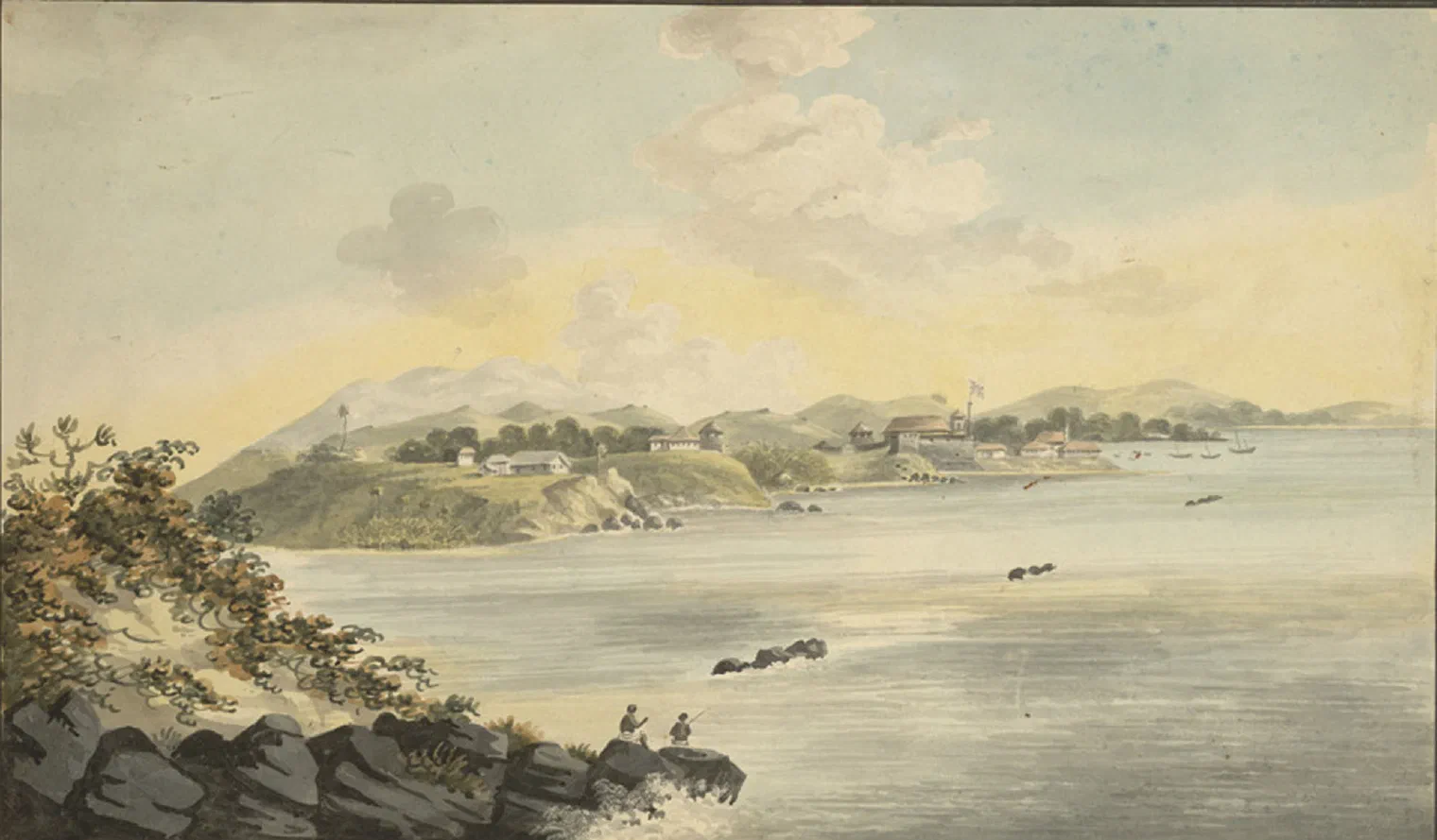
Pepper was the oldest and the biggest of these trades. The East India Company had kept a station at Tellicherry, in the picture above, since the late seventeenth century for one purpose: to buy pepper.
Nutmeg and cloves had a stranger history. The Dutch had held the Banda Islands since a brutal conquest in 1621, and guarded their monopoly fiercely. But in August 1810, while the Netherlands was under French rule, a small British force captured Banda Neira. For a few years the British held the islands, and they used the time to carry off nutmeg seedlings and plant them in their own colonies. The Dutch monopoly never recovered.
Cloth: the great reversal
For most of the eighteenth century, Indian cotton cloth was the finest and cheapest in the world. Calicoes, chintzes and the famous muslins of Dhaka, so fine they were called “woven air”, filled the Company’s ships. English weavers had once rioted against them, and Parliament had passed laws to keep them out.
Then the machines came. Spinning and weaving in Lancashire became so much cheaper that, by the end of the French wars, British cloth could undersell Indian cloth even in places where the two met on equal terms, such as West Africa. Indian cloth exports to Britain fell steeply.
The Charter Act of 1813, which let any British merchant trade with India, opened the Indian market to Lancashire too. British cloth began to pour in. Even so, Indian weavers were not swept away at once: the economic historians Stephen Broadberry and Bishnupriya Gupta estimate that British cloth had only about a tenth of the Indian market as late as 1850. But the direction was set. In 1813 the trade in cloth between Britain and India was turning around, and Bingley arrived just as it turned.
Timber
Bingley came to Calcutta with a ship full of Baltic pine, and he has a timber merchant’s eye. Bengal had its own hard, heavy timber, sal, used for beams, carts and boats. The best wood of all for ships was teak, which hardly rots, but it did not grow in Bengal. What little teak reaches Calcutta, Harcourt tells him, “comes either from the Malabar coast or from Burma.”
Teak made India a shipbuilding country. At Bombay, the Parsi master shipbuilder Jamsetjee Bomanjee Wadia was building warships for the Royal Navy out of Malabar teak, and they outlasted the oak ships built in England. One of them, the 74-gun HMS Cornwallis, was launched at Bombay on 12 May 1813, while Constance was still in the Atlantic.
What went the other way
Britain had always found it hard to sell things to India. For most of the Company’s history the gap was filled with silver: ships went out with chests of coin and came back with goods.
By 1813 that was changing. Ships from Britain carried:
- Woollen cloth, which the Company sent out in quantity, though India had little use for it.
- Metals: copper, iron and lead. (Constance carries a consignment of Swedish iron.)
- Naval stores: rope, canvas, tar.
- Wine and beer for the Europeans in India.
- And, from 1814, more and more cotton cloth and yarn from Lancashire.
A market that would not wait
The lesson Bingley learns in the warehouses is the one every newcomer learned. The goods were real and the profits were real, but the market had been arranged long before he arrived, by men with years of credit and connections. As Harcourt warns him, the opening that the Charter Act gave him was only “an advantage of timing”, and others would follow:
“Five years, perhaps six, and every man with sufficient credit will attempt the same.”
He was right. The private merchants poured in after 1814, and the old Company trade with India never recovered. What the Company kept, for twenty more years, was China. That is the last part of the series.
By Trade and by Trust is Volume Two of By Patience and by Paper. You can find it here.
Next in The Road East: Tea, Silver and Canton, on the trade the Company kept for itself.
Sources and further reading
- Stephen Broadberry and Bishnupriya Gupta, “Cotton Textiles and the Great Divergence: Lancashire, India and Shifting Competitive Advantage, 1600–1850”, Global Economic History Network conference paper, London School of Economics. Later published in the Economic History Review (2009).
- Anthony Webster, The Twilight of the East India Company: The Evolution of Anglo-Asian Commerce and Politics, 1790–1860 (Boydell Press, 2009).
- Royal Museums Greenwich, Cornwallis (1813), ship model.
- Wikipedia, for quick overviews: Indigo dye, Indigo revolt, Nil Darpan, Black pepper, Thalassery (Tellicherry), Banda Islands, Invasion of the Spice Islands, Cinnamon, Muslin, Calico Acts, HMS Cornwallis (1813), Shorea robusta (sal).
Comments
No account needed. Give a name, or leave it blank to post as Anonymous. Comments appear once the author has read and approved them.
Loading comments…