“What Is There to Allow?”: A History of Marrying Your Cousin, in England and India
The same marriage could be a family plan in Kent and a sin in Bengal. This is how that came about, and what people thought of it.
In By Harbour and by Hearth, Joseph Harcourt, an English merchant who has lived in Calcutta for more than twenty years, puts an odd question to Bankim, the young Bengali clerk in the office. Harcourt’s friend Charles Bingley cannot think what he means by it:
“Bankim. Is marriage between cousins allowed in your family?”
Bingley looked up in astonishment.
“Allowed? What is there to allow?”
“A great deal, in this country,” said Harcourt.
Bingley protests that he knows an English gentleman who has been “thought engaged to his cousin since he lay in his cradle”, and that nobody has ever found fault with it. That gentleman, as you might have guessed, is Mr. Darcy.
“Nor would they,” said Harcourt. “In England it is nothing at all. Here there are conventions, a great many of them, and they are not the same in every family.”
“What can be the objection?” asked Bingley.
“I am afraid I cannot answer your question,” said Harcourt with a laugh.
Why Harcourt asks is a matter for the book. But Bingley’s question deserves an answer, and so does the one behind it. How could the same marriage be a family plan in Kent, and a sin in Bengal?
The answer takes in a medieval Church council, Henry VIII, Charles Darwin, Queen Victoria, and a law book more than a thousand years older than any of them.
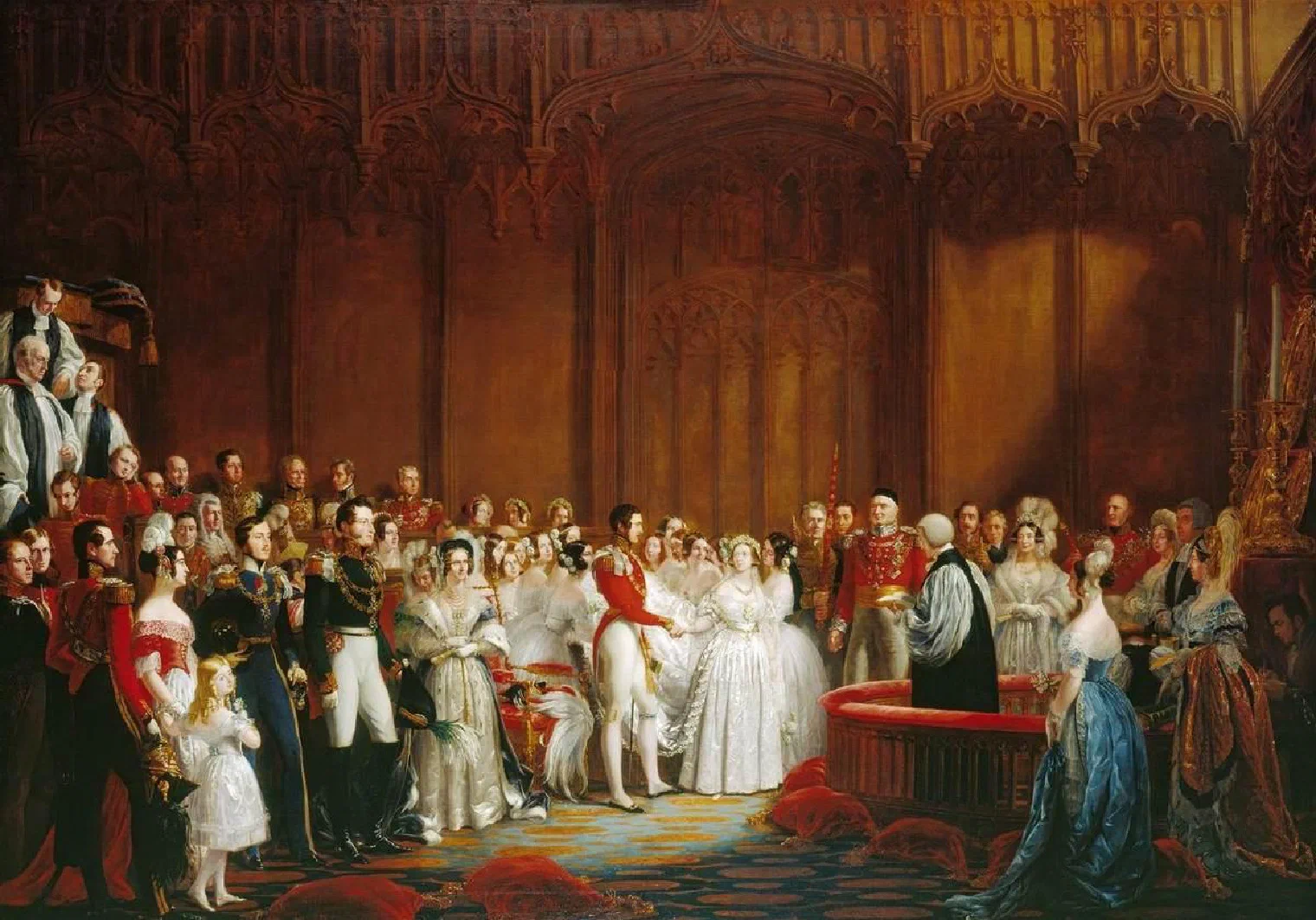

First: there are two kinds of cousin
English has one word, “cousin”, for all the children of your aunts and uncles. Much of the world has never treated them as one kind of person, and nothing in this story makes sense without the difference.
It all depends on the two parents in the middle, who are brother and sister to each other, and whose children are the cousins.
- If those two parents are the same sex (two sisters, or two brothers), the children are parallel cousins.
- If they are a brother and a sister, the children are cross cousins.
Darcy and Anne de Bourgh are parallel cousins, because Lady Anne Darcy and Lady Catherine were sisters. Jane Austen’s brother Henry and his wife Eliza were cross cousins, because Henry’s father and Eliza’s mother were brother and sister.
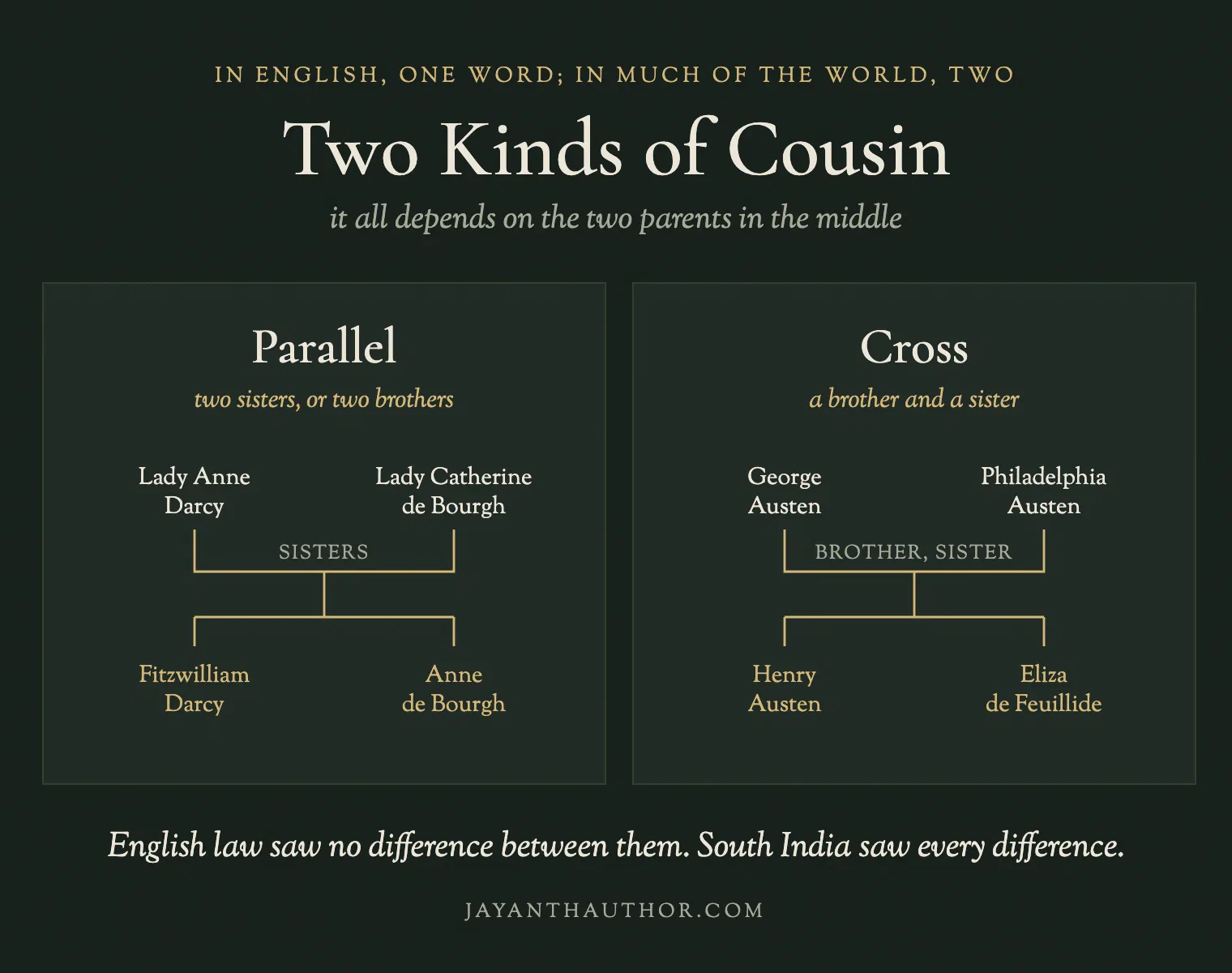
England drew no line between the two. South India built a whole way of life on that line.
England: from forbidden to free
For most of the Middle Ages, England’s law on this was the Church’s law, and first cousins could not marry without special permission.
- By the ninth century the Church had raised the ban to seven degrees of kinship, a circle so wide that it took in thousands of people. Few villagers could have kept such a rule, so the Church began granting dispensations. A dispensation was written permission from the Pope or a bishop to set a Church rule aside in one particular case. A couple who were too closely related could apply for one and then marry lawfully, and by the eleventh and twelfth centuries this had become common.
- In 1215 the Fourth Lateran Council cut the seven degrees to four. Even so, you needed a dispensation for anyone closer than a fourth cousin. Later, dispensations came with large payments to the Church, which meant that the rich could usually have what the poor could not.
Then came Henry VIII, who had his own reasons for taking an interest in who might marry whom. An Act of 1540 declared that all persons might lawfully marry who were “not prohibited by God’s law to marry”, and that no other prohibition should trouble a marriage outside “the Levitical degrees”: the relatives listed in chapter 18 of the Book of Leviticus. For a man, those are his mother and stepmother, his sister and half-sister, his granddaughter and his aunts. By marriage, they are his daughter-in-law, his brother’s wife, his wife’s daughter or granddaughter, and his wife’s sister while his wife is alive. Cousins are not on that list. In Europe, Martin Luther and John Calvin, the two great leaders of the Protestant Reformation, were saying much the same: the cousin ban was the Church’s rule, not God’s.
Henry’s elder daughter, the Catholic Queen Mary I, cancelled the Act. Her Protestant sister, Elizabeth I, brought it back. In the 1560s Matthew Parker, whom she had made Archbishop of Canterbury, the most senior churchman in England, drew up the Table of Kindred and Affinity, which went into the Book of Common Prayer. The list has been shortened since, but you can still read it. A man may not marry his mother, daughter, sister, aunt or niece, or any of a number of in-laws. Cousins are not on it, and never have been.
So by Darcy’s day, cousin marriage was not merely tolerated. It had been lawful in England for nearly three hundred years. A bridegroom applying for a marriage licence had to swear that he and his bride were not too closely related, and a first cousin could swear it with a clear conscience.
Austen’s England: legal, but was it liked?
Lawful is not the same as approved of. Here the picture is more interesting than Harcourt’s “nothing at all”.
The case for it was mostly property. Lady Catherine puts it to Elizabeth without embarrassment in Pride and Prejudice:
“While in their cradles we planned the union.”
A moment later she adds the point that matters: “Their fortune on both sides is splendid.”
A cousin match kept a fortune in the family, and this one would have joined Rosings to Pemberley. It also solved a practical problem. County society was small, and your cousins were among the few eligible people you actually knew.
Jane Austen’s own family did it. Her brother Henry married their first cousin Eliza de Feuillide in December 1797.
But there was unease. Jane Austen’s House describes first-cousin marriage in Georgian England as legal but usually discouraged. Austen shows that unease herself in Mansfield Park. When Sir Thomas Bertram is asked to take in his penniless niece Fanny, this is what crosses his mind:
He thought of his own four children, of his two sons, of cousins in love, etc.
Mrs. Norris has her answer ready:
“… do not you know that, of all things upon earth, that is the least likely to happen, brought up as they would be, always together like brothers and sisters? It is morally impossible.”
Notice what is missing here. Neither of them mentions health or blood. As I read it, Sir Thomas’s fear is that one of his sons will throw himself away on a girl with no money. And Mrs. Norris does not argue that cousins may not marry, only that children brought up as brother and sister will never want to. Austen then proves her wrong: Fanny marries her cousin Edmund, and the novel is on their side. (Modern readers often find this hard to take. Mary Jean Corbett’s article looks at the argument over it.)
Keep that phrase in mind: “like brothers and sisters”. We will meet the idea again in India, where it was not an argument but the rule.
The Victorian scare
Disapproval on grounds of blood is a later story, and its most famous worrier was a nervous father.
Charles Darwin married his first cousin, Emma Wedgwood, in 1839. They had ten children, three of whom died young. The death of his beloved daughter Annie, at ten, in 1851 left him wondering whether the fault lay in his marriage. He spent years proving that plants did better when crossed than when bred with themselves, and he could not help applying this at home.
He was not alone. In 1865 Arthur Mitchell, a Scottish lunacy official, published a study linking cousin marriage with harm to children. In America, an 1858 report by Dr. Samuel Bemiss had already raised the same fear, and thirteen American states and territories had banned such marriages by the 1880s.
Britain did something different: it refused even to count. In 1870 John Lubbock, a banker and scientist who had grown up near Darwin’s home and had just been elected to Parliament, proposed adding a question on cousin marriage to the census. Darwin wrote to him urging it on: the returns could show whether cousins had fewer children, and whether their children were more often deaf or blind.
The House of Commons was not impressed. It already spent time every year arguing over whether a man might marry his dead wife’s sister. One member objected that if first cousins were added, “the whole time of the House would be taken up in deciding who was to be allowed to marry anybody else”. The motion lost by ninety-two votes to forty-five. George Darwin later wrote that it was rejected “amidst the scornful laughter of the House, on the ground that the idle curiosity of philosophers was not to be satisfied”.
Darwin was stung enough to complain in The Descent of Man the next year of “ignorant members of our legislature” who had rejected the plan “with scorn”.
So he gave the work to his son. George Darwin, a mathematician, published the results in 1875, and the historian Adam Kuper gives the figures. These are George’s estimates of the share of marriages that were between first cousins:
| Group | First-cousin marriages |
|---|---|
| Aristocracy | About 4.5% |
| Landed gentry and upper middle class | About 3.5% |
| Country districts | About 2.25% |
| London | About 1.15% |
Note that these are figures for the 1870s. I could not find a reliable one for the Regency. Kuper says the rate among the better-off held steady at about 4 to 5% through much of the nineteenth century, which suggests that Bingley’s world was not very different.
Next, George went to the asylums. Between 3 and 4% of the patients there were the children of first cousins, almost the same as the share of such marriages in the population as a whole. He looked at the claims about blindness, deafness and childlessness too, and found no convincing evidence for those either. His one caution was that the practice might be quite all right for the rich but bad for the poor, whose children were worse fed and housed.
Francis Galton, Charles Darwin’s half-cousin and a pioneer of statistics, was delighted. He told George that he had “exploded most effectually a popular scare”, and joked that he could make a fortune by publishing a little book called Words of Scientific Comfort and Encouragement to Cousins who are Lovers. Cousins who fell in love and did not marry, he added, would buy it too.
Many families were relieved, says Kuper. Their Queen had married a first cousin, after all, and landowners in the House of Lords already “knew that the inbreeding of good stock was sound policy”.
The rate then fell sharply after the First World War. By the 1930s only about one marriage in 6,000 was between first cousins. That was probably less to do with science than with smaller families and a far wider world for the young to meet in.
South India: the cousin you were meant to marry
Now take Bingley’s question to Madras, and the answer turns upside down.
Across most of South India, in many communities, it mattered a great deal which kind of cousin you had. The easiest way to see this is to send two of our Englishmen there.
Darcy could not marry Anne. Anne’s mother is his mother’s sister. In a Tamil family, your mother’s sister is your second mother and your father’s brother is your second father, so their children are your brothers and sisters. You call them by the same words you use for your own. To a Tamil family, Darcy marrying Anne would be Darcy marrying his sister.
Henry Austen could marry Eliza. Eliza’s mother is his father’s sister. That puts Eliza on the other side of the family, and she is exactly the kind of girl he might marry. In many families she was the expected choice. Tamil has one word, maman, for both your mother’s brother and your father-in-law, because they were so often the same man.
In some communities a man could even marry his own sister’s daughter. Yes, you read that right. This goes beyond cousin marriage, but it follows the same logic. A young woman’s mother’s brother is on the other side of her family. Her father’s brother is her second father, and she could never marry him, but her mother’s brother was another matter, and in some communities the match was encouraged. In England, by contrast, a niece was on the forbidden list.
The custom is very old. An ancient Sanskrit law book, the Baudhayana Dharmasutra, lists a few southern habits that troubled the north. They include eating with your wife, eating stale food, and marrying “the daughter of a maternal uncle or of a paternal aunt”. The writers could not agree what to do about it. Some said each region should keep to its own ways, and others said that was wrong. Northern law books mostly went on disapproving, and the South went on marrying its cousins.
The Tamil evidence points the same way. The scholar George Hart, who studied the old Tamil poems and stories, calls such marriages “virtually certain” in ancient South India.
Why did families want it? Scholars disagree, but two reasons come up most often.
- It kept two families close. A family gave a daughter in marriage, and a generation later her daughter or son could marry back into it. The tie was renewed each time.
- A bride did not go to strangers. Her husband’s parents were her own aunt and uncle, who had known her all her life, and she stayed close to the men who already looked after her.
Lady Catherine would have understood the first reason perfectly.
The custom is still common. In India’s national survey of 2015–16, about 10% of marriages across the country were cousin marriages. In Tamil Nadu the figure was nearly 30%.
Bengal and the North: no cousins at all
Harcourt is in Calcutta, though, not Madras, and in Bengal the rule was stricter. There, neither kind of cousin would do. This is the objection Bingley asks about, and it has nothing to do with health.
The rule goes back to the Laws of Manu, the best known of the old Hindu law books. Put simply, a man had to marry outside his family, and “family” was drawn very wide. There were two tests:
- The father’s line. Every family belonged to an ancient line called a gotra. Everyone in it counted as kin, however distant, so a man had to marry out of it.
- Near relatives on both sides. A man also could not marry a sapinda, a close relative on his father’s or his mother’s side. The word comes from pinda, the ball of rice offered to the dead, and people joined by those offerings counted as one family. The circle reached seven generations back on the father’s side and five on the mother’s.
Bengal took these rules from Raghunandana, its great sixteenth-century scholar of the law.
Now run our two Englishmen through them.
Darcy and Anne share a grandfather, only two generations back. Forbidden.
Henry and Eliza share a grandfather too. Forbidden, even though the South would have approved. Raghunandana even quotes an older text that names these very cousins. A man who had married his father’s sister’s daughter or his mother’s brother’s daughter was to leave her, do penance, and go on supporting her.
So the marriage that was proper in Madras called for penance in Calcutta.
This is the real answer to Bingley. To him a cousin is a pleasant young lady outside his immediate family. To a family in Bengal, a cousin is immediate family. Marrying her is not imprudent; it is marrying your sister. Mrs. Norris’s “like brothers and sisters” was the plain truth of the matter there, and the language says so too. In Bengali a female cousin is a kind of bon, a sister: your mother’s brother’s daughter is your mamato bon.
Three things stop this from being as neat as it sounds:
- The limits were so wide that they had to give way. Seven and five generations could rule out most of a village. So the commentators softened the rule. A woman took her husband’s gotra at marriage, so a family link could pass out of one gotra and into another. A girl who was at least three gotras apart from the man could be allowed, even if she fell inside the count. How far the ban reached beyond first cousins was therefore open to question, and it is just as Harcourt says: “they are not the same in every family”.
- The law books were not the whole of life. They were written by Brahmin scholars, chiefly with the higher castes in mind, and practice differed by caste and place.
- It was not always so. Very early Sanskrit texts seem to accept such marriages: one speaks of a maternal uncle’s or paternal aunt’s daughter as a man’s natural share, and another says, “In the third or fourth generation we unite.” The great epic, the Mahabharata, has Arjuna carry off Subhadra, who appears to be his mother’s brother’s daughter, though Trautmann warns that this single case proves little.
Across most of North India, the Hindu rule still holds. Cousin marriage there is seen as incest, and in Himachal Pradesh the share of such marriages falls to about 0.5%.
Calcutta’s other rule book
Harcourt says “this country”, but Calcutta had more than one set of rules. Bingley’s question would have had a different answer from a Muslim family in the same street.
Islamic law does not forbid first cousins to marry, of either kind. Among Bengali Muslims, one reference work says, cousin marriage is common, though “neither pervasive nor necessarily preferred”.
A parlour game
Here is what it all comes to. Take five couples, some real and some fictional, and ask what each of the four sets of rules would have said. (This is only a game. No one at Rosings was ever bound by the law of Bengal.)
| Couple | Kind of cousin | England | South India | Bengal, Hindu | Muslim law |
|---|---|---|---|---|---|
| Darcy and Anne de Bourgh | Parallel | Allowed | Forbidden: she is his sister | Forbidden | Allowed |
| Fanny Price and Edmund Bertram | Parallel | Allowed | Forbidden: he is her brother | Forbidden | Allowed |
| Henry Austen and Eliza | Cross | Allowed | A proper match | Forbidden | Allowed |
| Charles Darwin and Emma Wedgwood | Cross | Allowed | A proper match | Forbidden | Allowed |
| Queen Victoria and Prince Albert | Cross | Allowed | A proper match | Forbidden | Allowed |
There is one joke in that table that I cannot resist. Lady Catherine’s great scheme, planned over two cradles, is the one kind of cousin marriage that would have shocked both Madras and Calcutta. Her sister’s son would have been her daughter’s brother.
And now
The old divisions have not gone away.
- India: the Hindu Marriage Act of 1955 brought the limits down to three generations through the mother and five through the father, and kept the exception for any community whose custom allows it. So the South’s cross-cousin marriages remain lawful, while the old rule of the North became a statute. Muslim personal law still allows first cousins.
- England and Wales: first cousins may still marry. In December 2024 an MP brought in a bill to ban such marriages, but the government said it had no plans to change the law, and I can find no sign that the bill has passed.
- America: about half the states ban first-cousin marriage.
- The science: the worry that troubled Darwin was not imaginary, but it was smaller than he feared. A 2002 review put the added risk of a serious genetic condition or birth defect at about 1.7 to 2.8 percent for the children of first cousins, on top of the risk every couple runs. The authors stressed that no single figure fits every group.
Back to Calcutta
Harcourt, you will remember, could not answer. He had “often heard the opinion” and “never troubled to inquire why it is held”, which may be the most honest thing an Englishman in India ever said.
Bankim, however, does have an answer:
“Padma is not my first cousin. Her grandmother and my grandfather were sister and brother.”
Bingley attempted to follow the relationship, and gave it up.
“That might be distant enough,” said Harcourt. “I cannot pretend to know for sure.”
We can do better than Bingley. If Padma’s grandmother and Bankim’s grandfather were sister and brother, then the two young people share a great-grandfather. They are second cousins. Now run them through the two tests:
- The father’s line. Padma’s grandmother married out of the family and took her husband’s gotra, so Padma and Bankim belong to different gotras. They pass.
- Near relatives. Their great-grandfather is only three generations back, well inside the limit of five or seven. On the strict rule, they are too close.
But the strict rule had been softened, and one family might apply it where another would not. So “might” is exactly the right word for Harcourt to use. Whether it is distant enough, and what comes of it, are for the book to tell. By Harbour and by Hearth is the third volume of By Patience and by Paper. You can find it here.
Sources and further reading
- Adam Kuper, “Incest, Cousin Marriage, and the Origin of the Human Sciences in Nineteenth-Century England”, Past and Present 174 (2002), pp. 158–183, and Incest and Influence: The Private Life of Bourgeois England (Harvard University Press, 2009). His fuller accounts of the English side.
- Adam Kuper, “Kissing Cousins”, New Humanist (2009). A short version: Mitchell, Lubbock, the Darwins and the figures given above.
- George H. Darwin, “Marriages Between First Cousins in England and Their Effects”, Journal of the Statistical Society 38 (1875). Darwin Online.
- Charles Darwin to John Lubbock, 17 July 1870. Darwin Correspondence Project.
- Thomas R. Trautmann, “Cross-Cousin Marriage in Ancient North India?”, and George L. Hart III, “Some Aspects of Kinship in Ancient Tamil Literature”, both in Kinship and History in South Asia, ed. Trautmann (University of Michigan, 1974). Free to read.
- Gobinda Chandra Mandal, “Revisiting Hindu Marriage Norms: Unveiling Women’s Agency in Ancient India”, Journal of the Asiatic Society of Bangladesh (Humanities) 69 (2024), pp. 1–32. On Manu, Narada and Raghunandana; it draws on D. N. Mitter’s The Position of Women in Hindu Law.
- Mary Jean Corbett, "‘Cousins in Love, &c.’ in Jane Austen", Tulsa Studies in Women’s Literature 23 (2004), pp. 237–260.
- The Baudhayana Dharmasutra, trans. Georg Bühler (1882), Sacred Books of the East, vol. 14.
- “A Table of Kindred and Affinity”, Book of Common Prayer. The Church of England.
- “Marriages Bill”, House of Lords, 25 February 1851, Hansard. Quotes the 1540 Act and the older canon law.
- Jane Austen’s House, "‘Cousins in Love’: A Controversial Marriage", from the online exhibition Mansfield Park: Courting Controversy.
- Charles Darwin, The Descent of Man (1871), closing chapter.
- University of Washington, “First cousins face lower risk of having children with genetic conditions than is widely perceived” (2002), on Bennett and others in the Journal of Genetic Counseling.
- “Bengali: Marriage and Family”, Countries and Their Cultures.
- The Bible, King James Version, Leviticus 18:6–18. Project Gutenberg.
- Jane Austen, Pride and Prejudice (1813), chapter 56, and Mansfield Park (1814), chapter 1. Project Gutenberg.
- Progress Educational Trust, “Bill introduced to ban cousin marriage”.
- iPleaders, “All you need to know about sapinda relationships”. On the Mitakshara and Dayabhaga explanations.
- “Tamil: Kinship”, Countries and Their Cultures.
- Groundviews, “A-Z of Sri Lankan English: C is for Cousin Brother” (2010). On Tamil words for cousins.
- Wikipedia, for quick overviews and the survey figures: Cousin marriage, Sapinda, Henry Thomas Austen.
Comments
No account needed. Give a name, or leave it blank to post as Anonymous. Comments appear once the author has read and approved them.
Loading comments…