“You Must and Shall Be Married by a Special Licence”: How to Get Married in Regency England
Banns, common licences and special licences, and whether Mrs. Bennet could ever have had her way.
In By Harbour and by Hearth, Charles Bingley has just been accepted by Jane, and he has no wish to wait:
“Tomorrow,” he repeated. Then, with sudden practicality, “Or the earliest day upon which I can obtain a common licence. … I should prefer not to wait through three Sundays for the banns.”
The licence takes a day longer than he hoped, and Bingley is so disappointed that he becomes, in the book’s words, “an object of general amusement”.
Bingley knew exactly what to ask for. Jane’s mother had once asked for something much grander. When Elizabeth Bennet tells her mother she is to marry Mr. Darcy, Mrs. Bennet takes a moment to catch up. Then she follows her daughter upstairs:
“My dearest child, I can think of nothing else. Ten thousand a year, and very likely more! ’Tis as good as a lord! And a special licence. You must and shall be married by a special licence.”
Readers of By Patience and by Paper know that Elizabeth marries him in the end, as she always does. But what was Mrs. Bennet asking for? What was a special licence, who could get one, and could Darcy? And if not, how did people actually get married in 1813?
Here are the practicalities, as plainly as I can put them.

First, the rules
From 1754 every wedding in England and Wales was governed by one law: Lord Hardwicke’s Marriage Act of 1753, passed “for the better preventing of clandestine marriages”. Before it, a couple could be married quickly and secretly by an obliging clergyman, most notoriously in and around the Fleet prison in London. After it, a valid wedding needed:
- a Church of England ceremony, performed by a Church of England clergyman;
- in a parish church or public chapel;
- after either banns or a licence;
- two witnesses, and an entry in the parish register signed by the couple, the witnesses and the clergyman.
A clergyman who married a couple any other way could be transported to the colonies. Only three groups stood outside the Act: Quakers, Jews and the royal family. Everyone else, Catholics and Methodists and Baptists included, had to marry in the parish church like their neighbours. (Regency History has a good summary.)
That left three ways in.
| Banns | Common licence | Special licence | |
|---|---|---|---|
| Who gave it | The parish clergyman read them out | A bishop’s office, or a local clergyman acting for him | The Archbishop of Canterbury only |
| Who could have one | Anyone | Anyone who could swear there was no impediment | Mainly peers, MPs, judges, baronets and knights |
| Rough cost | Next to nothing | About £1 to £3 | About £25 to £30 (sources differ) |
| Shortest wait | About three weeks | None once granted | None once granted, but getting one took time |
| Where | A church where the banns were read | The church named in the licence | Anywhere: a house, a drawing room, a private chapel |
| What time | 8 a.m. to noon | 8 a.m. to noon | Any hour |
Door one: banns
This was how most people married, and it cost almost nothing.
- The couple gave the clergyman a week’s notice in writing: their names, where they lived, and how long they had lived there.
- He then read out the banns in church on three Sundays: “I publish the banns of marriage between…”, asking anyone who knew a reason they should not marry to say so.
- If the two lived in different parishes, the banns were read in both, and the clergyman who married them needed a certificate from the other parish saying it had been done.
- The wedding had to take place in one of those churches, and within three months of the last reading. After that, the banns had to be read all over again.
So the quickest a banns wedding could happen was about three weeks from giving notice, and that was for a couple in the same parish.
For a couple from two parishes it took longer. Take Darcy and Elizabeth. Their banns would be read at Longbourn and in Darcy’s parish in Derbyshire. Only after the third reading could the Derbyshire clergyman write out his certificate, and only when it had travelled down to Hertfordshire could the wedding go ahead. With a week’s notice, three Sundays and then the post, that is comfortably more than three weeks.
Gentlefolk tended to look down on banns. Having your names read out to the whole parish, three weeks running, felt a little common, and a little too public. That is why so many of Jane Austen’s characters reach for a licence instead.
Door two: the common licence
A common (or ordinary) licence let a couple skip the banns. It was what most of the gentry used.
Who gave it
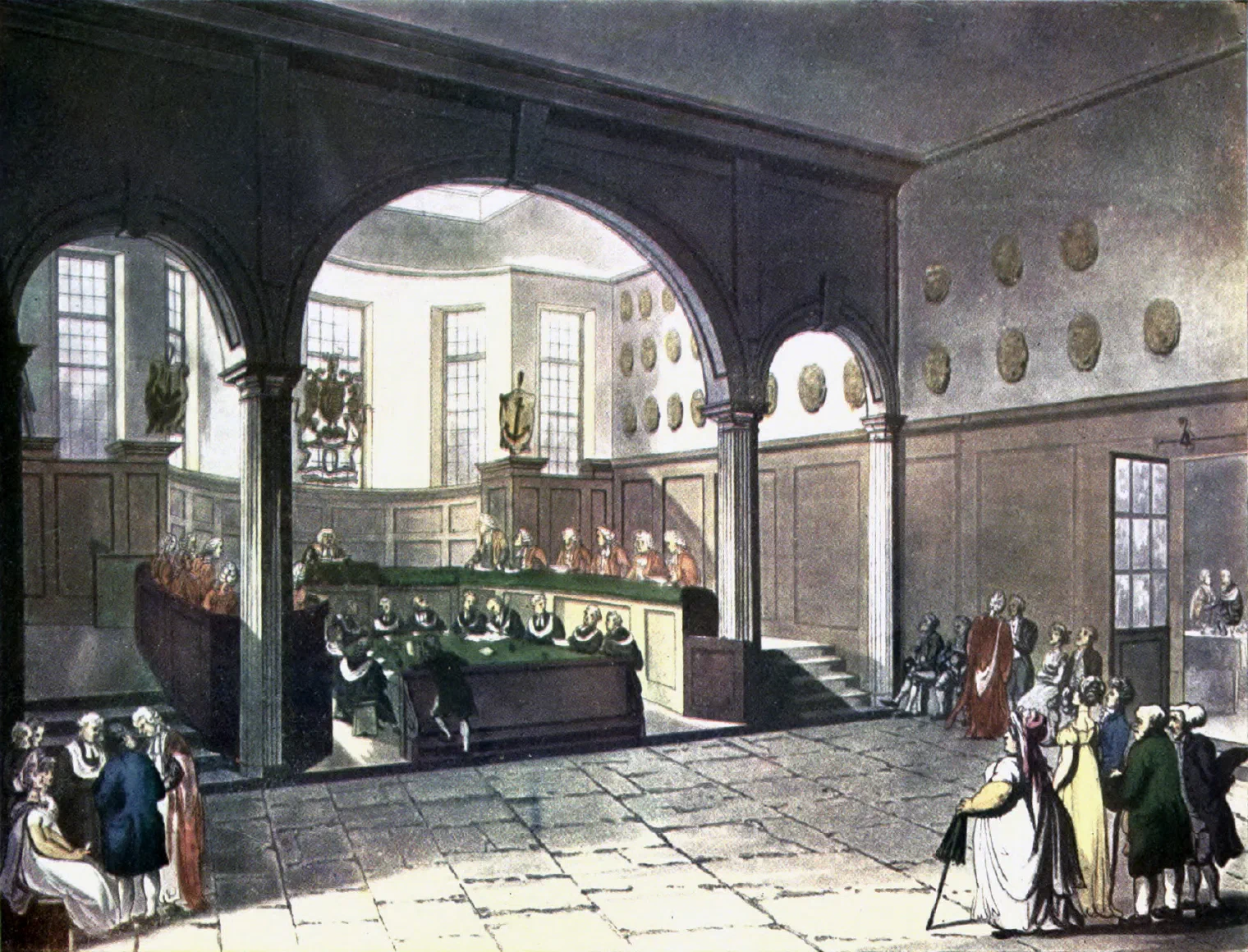
The bishop of the diocese, through his office. In practice it was usually granted by one of his officials, or by a local clergyman appointed as his deputy, called a surrogate. In London you went to Doctors’ Commons, the little world of church lawyers near St. Paul’s shown in the picture above. If the bride and groom lived in different dioceses, the Archbishop’s office there could issue it too (FamilySearch explains who had the right to issue licences).
What you had to do
Usually the groom went in person and swore an allegation: a statement on oath giving both names, ages and parishes, and swearing that there was no reason they could not marry, such as being too closely related, or already married.
Before 1823 he also signed a bond, usually with a friend, promising to pay a large sum (anything from £40 to £200) if the allegation turned out to be false. Nobody paid it unless they had lied.
Where you could marry
Only in the church named in the licence. And the 1753 Act said that church had to be in the parish where one of the couple had lived for at least four weeks. Only one of them. The bride’s home parish was the usual choice.
This is what makes a common licence so quick for the right couple, and why Bingley’s wait in By Harbour and by Hearth is so short. Jane has been living at Pemberley for years, so her four weeks in the parish are long since served, and Bingley has to wait only about two days.
The four weeks were not always strictly checked, and a man could take lodgings to meet them. Lydia Bennet explains her own wedding in exactly these terms:
“We were married, you know, at St. Clement’s, because Wickham’s lodgings were in that parish.”
How long it lasted
A licence was good for three months. Once you had it, you could marry that same morning or any day after.
What it cost
Here the sources do not quite agree, and the exact fee varied from one diocese to another:
- In 1730 a fee of about five shillings was normal (FamilySearch).
- On top of the fee the licence carried a government tax stamp of about ten shillings (Jane Austen’s London).
- By 1850 the usual price at Doctors’ Commons was £2 12s. 6d., with half a guinea more for a minor, and country surrogates were said to charge more (Household Words, 1850).
So for a wedding in Austen’s day, think of something between one and three pounds. Not cheap for a farm labourer; nothing at all to a Bennet.
Door three: the special licence
This is the one Mrs. Bennet wanted, and the one every Regency romance seems to keep in a gentleman’s pocket. It was far rarer than novels suggest.
What made it special
- Only the Archbishop of Canterbury could grant one, through his Faculty Office at Doctors’ Commons.
- The couple could marry anywhere: at home, in a drawing room, in a private chapel.
- At any time of day.
- With no residence rule and no banns.
It was not a right. The Archbishop granted it as a personal favour.
Who could get one
From 1759 the Archbishops generally kept special licences for a short list of people:
- peers and peeresses, and their children;
- privy councillors;
- judges;
- baronets and knights;
- Members of Parliament.
Anyone else had to show “very strong and weighty reasons” (Liberta Books and Jane Austen’s World both give the list). Even a peer was not guaranteed one.
The numbers show how rare they were: six special licences in 1730, twenty-two in 1830, against about 2,700 common licences a year from the same offices (FamilySearch).
What it cost
Another place where the sources differ, so here are all three:
- Several Regency writers give fees of more than twenty guineas, plus a tax stamp of £4 to £5: about £25 to £30 in all.
- Jane Austen’s World gives £5, a figure reached around 1811. That may be the stamp alone.
- FamilySearch gives an average of about £30, but for the end of the nineteenth century.
I could not find the official fee table for the 1810s. “About £25 to £30” is my best estimate, and I’d be glad to hear from anyone who has seen the real figure.
How quickly could a couple marry?
The 1753 Act built the waiting into banns: a week’s notice, then three Sundays. That is the slow road, and it was meant to be.
For a licence, the Act’s only rule about time looks backwards: one of the couple must have lived in the parish for four weeks before the licence was granted. It says nothing about waiting after. A bride marrying from the house she had grown up in had already served her four weeks many times over.
Real licences bear this out:
- A surviving licence for a wedding at St. Andrew’s, Holborn, was issued on 8 May 1805 and used on 10 May 1805, two days later (Jane Austen’s London).
- Ralph Rylance’s Epicure’s Almanac (1815) describes a tavern beside Doctors’ Commons where “the fond expectant bridegroom sips his soup or savoury jelly, waiting for his licence”. He was not planning to wait a week.
The special licence had no waiting period once granted either. The Act expressly kept the Archbishop’s old right of “granting Special Licences to marry at any convenient Time or Place”. Getting one was another matter. You applied in London, and the Archbishop had to agree to do you a favour, which could take some days. Nobody chose a special licence to save time. They chose it for the privilege of marrying at home, and for what it said about who they were.
So the quickest lawful way to marry in England was a common licence, in the parish where one of you already lived. The quickest way of all was to leave England (more on that below).
So, could Mr. Darcy get one?
Money was no obstacle. On ten thousand a year, Darcy earns about £27 a day. A special licence would cost him roughly one day’s income.
Rank was the problem. Darcy is a gentleman of very old family, but he is a commoner. He holds no title. Austen never says he sits in Parliament. His uncle is an earl, but an earl’s nephew is not on the Archbishop’s list; only an earl’s own children are.
So Darcy would have had to ask, and give the Archbishop a reason. There was no hurry (the families approved, nobody was ill, the bride lived in her own parish), so he had no very weighty reason to offer. Could a word from the Earl or from Lady Catherine have helped? Quite possibly. The Archbishop could grant it to whomever he liked. Lady Catherine, of course, was in no mood to put in a word.
That is the joke in Mrs. Bennet’s line. "‘Tis as good as a lord!" she cries, and then asks for the one thing a lord could have and Darcy, strictly, could not.
Austen never tells us how Elizabeth and Darcy did marry. The likeliest answer is a common licence, with the wedding in Longbourn church, since that was Elizabeth’s parish and she had lived there all her life. Darcy needed no residence of his own.
And one more thing Darcy needed
Earlier in the book, Elizabeth tells Lady Catherine: “I am not one-and-twenty.” She was a minor, and that changed things.
Marrying under twenty-one
Anyone under twenty-one who had not been married before needed the consent of their father, or a guardian, or failing both, their mother.
- By licence, the consent had to be given before the licence was issued. A minor’s licence marriage without it was void: not a marriage at all.
- By banns, a parent could stand up in church and forbid them, which stopped the wedding. But a parent who stayed silent could not object afterwards.
So when Darcy went into Mr. Bennet’s library to ask for Elizabeth, it was not only a courtesy. Without her father’s yes, there could be no licence. Lydia, at sixteen, was in the same position: her wedding to Wickham could not go ahead until Mr. Bennet agreed to it.
What time of day?
Before noon. The church’s own rules of 1604 set the hours for a wedding at eight in the morning to twelve noon, and a wedding outside them was irregular. (A special licence was the exception.) Lydia knew it:
“My uncle was to give me away; and if we were beyond the hour we could not be married all day.”
That is why the Regency wedding feast is a wedding breakfast. The window was not widened to three in the afternoon until 1886.
Which church?
To put it all together:
- By banns: a church where the banns had been read, so the parish of the bride or the groom.
- By common licence: the one church named in the licence, in a parish where one of them had lived for four weeks.
- By special licence: anywhere at all.
Note what was not allowed. A private chapel in a great house, Pemberley’s or Sotherton’s, could not be used for a wedding without a special licence. When the party visits the chapel at Sotherton in Mansfield Park, Julia Bertram teases her sister, who is engaged to its owner:
“Upon my word, it is really a pity that it should not take place directly, if we had but a proper licence, for here we are altogether, and nothing in the world could be more snug and pleasant.”
The joke works because everyone in the room knew a “proper licence” for a chapel meant the Archbishop’s.
Over the border
None of this applied in Scotland, which kept its old law. There a couple could marry simply by declaring themselves husband and wife in front of witnesses, with no banns, no licence, no clergyman and no parent’s consent, even under twenty-one. That is why runaway couples headed north to Gretna Green, the first village over the border on the road from England, and why the Bennets’ first question about Lydia was whether she had gone to Scotland.
When it changed
- 1823: a new Marriage Act cut the residence rule from four weeks to fifteen days, put the eight-to-noon hours into the law itself, and dropped the bond.
- 1836: the Marriage Act 1836, in force from July 1837, allowed weddings in register offices and in Catholic and Nonconformist chapels at last.
- 1886: the hours were extended to three in the afternoon.
The Archbishop’s special licence still exists. It is now used mainly for couples with a real link to a church where they could not otherwise marry, and the Faculty Office still issues it.
Back to Longbourn
Mrs. Bennet never gets her special licence, as far as Austen tells us. But she gets three daughters married, which, by her own reckoning, is better.
What becomes of them all, and of one lie told in a London parlour, is a story for the books. By Fable and by Fact is Volume One of By Patience and by Paper. You can find it here.
And getting married, as the next post explains, was the easy part. Getting out of a marriage was another matter entirely: “This Is No Separation in Law”: How Divorce Worked in Regency England.
Sources and further reading
- Rebecca Probert, Marriage Law and Practice in the Long Eighteenth Century: A Reassessment (Cambridge University Press, 2009). The standard modern study of how the 1753 Act worked in practice.
- An Act for the Better Preventing of Clandestine Marriages (26 Geo. II c. 33, 1753), full transcribed text (archived copy).
- Ralph Rylance, The Epicure’s Almanac (1815), as quoted in Jane Austen’s London (below).
- FamilySearch Research Wiki, “Marriage Allegations, Bonds and Licences in England and Wales”. Who issued licences, fees, bonds and the numbers of special licences.
- Regency History, “Banns, licences and Hardwicke’s Marriage Act”.
- Jane Austen’s London, “Banns or Licence? Ways to Marry in Georgian England” (2014).
- Brenda S. Cox, “Banns, Common Licenses, and Special Licenses: Permission to Marry in Jane Austen’s England”, Jane Austen’s World (2021). Draws on Burn’s Ecclesiastical Law (1797).
- Liberta Books, “Special Licence Marriage: Heyer’s Research Failing?”. On the Archbishop’s list of who qualified.
- Household Words, vol. 1 (1850), page 377, on licence fees at Doctors’ Commons. (Dickens Journals Online.)
- The Faculty Office of the Archbishop of Canterbury, “Do I need a Special Marriage Licence?”.
- Jane Austen, Pride and Prejudice (1813), chapters 29, 51 and 59, and Mansfield Park (1814), chapter 9. Project Gutenberg.
- Wikipedia, for quick overviews: Clandestine Marriages Act 1753, Marriage Act 1836, Faculty Office, Doctors’ Commons, Fleet marriage, Gretna Green.
Comments
No account needed. Give a name, or leave it blank to post as Anonymous. Comments appear once the author has read and approved them.
Loading comments…