“Through a Distant Entail”: Who Gets Longbourn, and Other Questions About Entails
A reader's question about a second son's inheritance, and every other question about entails I could think of.
Early in By Trade and by Trust, the second book of By Patience and by Paper, Charles Bingley writes to Darcy about the man now calling on his sister Caroline:
“His name is Frederick Lowe, the second son of the Earl of Medbury. He is in possession of Fernside Hall, near Penrith in Westmorland, which came to him through a distant entail, and which will pass to another claimant if he dies without an heir.”
Soon after the book came out, a reader wrote to me with a very good question. How can a second son inherit an estate when his elder brother is still alive? Doesn’t the eldest son get everything?
Answering it set me thinking about all the other things readers of Pride and Prejudice wonder about the entail on Longbourn. So here they are, as simply as I can put them.

First, what was an entail?
If you own a house outright, you can sell it, borrow against it, or leave it to anyone you like.
An entail took that freedom away. Some ancestor, often long dead, signed a document saying, in effect:
This land goes to my son, then to his son, then to his son, for ever. If the sons run out, it goes to my brother’s sons.
The man living on an entailed estate was more a keeper than an owner. He could live there, collect the rents and farm the land. But he could not sell it, and he could not leave it to his daughters, unless he first found a way to break the entail (more on that below). When he died, it went to whoever came next in that old document, whatever he wanted. (The idea goes back to a law of 1285 called De Donis.)
Three things to remember:
- The document decides everything. Every entail was worded a little differently.
- The estate passes the moment the owner dies. Nobody has to sign anything or accept it.
- An entail could be broken, but only by certain people, in a certain way. More on that below.
What Austen tells us about Longbourn
In chapter 7:
“Mr. Bennet’s property consisted almost entirely in an estate of two thousand a year, which, unfortunately for his daughters, was entailed, in default of heirs male, on a distant relation.”
And in chapter 50, explaining why Mr. Bennet never saved any money:
“When first Mr. Bennet had married, economy was held to be perfectly useless; for, of course, they were to have a son. This son was to join in cutting off the entail, as soon as he should be of age, and the widow and younger children would by that means be provided for.”
Notice the word join. Mr. Bennet could not break the entail alone. He needed a grown-up son to do it with him. So the likeliest picture is this: Mr. Bennet held Longbourn for his lifetime only. After him came his sons, if he had any. After them came the Collins family.
Austen never shows us the actual document, and lawyers still argue about the details (the law professor Peter Appel has written a whole article on it). So the answers below are what usually happened.
How could a second son inherit, with his brother alive?
This is my reader’s question. The answer is that a noble family did not own one big pot of property that all went to the eldest son. It owned separate things, and each one followed its own rules:
- The title. The earldom goes to the eldest son.
- The family estate. Medbury Park usually goes to the eldest son too.
- Anything else. An estate that came from a different family follows that family’s document, written by different people, perhaps a hundred years earlier.
Fernside is in the third group. It does not come from the Earl of Medbury at all. It comes from another family, “through a distant entail”, and goes to whoever their document names.
And that document could easily skip an elder brother. The person who wrote an entail could set any rules they liked, and they often had good reasons to pass over an eldest son:
- To keep two estates apart. Some families did not want their house swallowed up by a grander one. So they added a rule: if the next heir already owns another estate, or will become a lord, skip him and go to the next in line. An elder son who was going to be an earl was exactly the person such a rule was meant to skip.
- To look after younger sons. A document could simply name “the second son”, because the eldest was already provided for.
So a second son inheriting while his brother lived was not strange at all. Bingley’s letter doesn’t say which rule brought Fernside to Frederick, and Frederick himself is as surprised as anyone, but nothing in the law stood in the way.
And why can’t Frederick sell Fernside?
Later in the book, Frederick’s father and brother tell him to sell Fernside for cash. He says he cannot: he has “but two choices: neglect it or improve it.”
That is exactly the position of a man who holds an estate for his lifetime only. He can live there and spend his own money improving it. But he cannot sell it, because it is not entirely his. The next heir’s rights are waiting behind his own. Mr. Bennet was very likely in the same position at Longbourn.
What if Mr. Collins died before Mr. Bennet?
Then Longbourn would go to the next person named in the document.
- If Mr. Collins had a son, the son would inherit, even as a baby. Someone would run the estate for him until he grew up.
- If he had no son, it would go to the next male relative who fitted the document: a Collins uncle or cousin.
- If there was no one at all who fitted, the entail would simply run out. The land would then pass by the ordinary rules of inheritance. And under those rules, when there were no sons, daughters inherited equally, sharing the land between them. (Lawyers called sisters who shared land like this coparceners.)
That last case is the only way the law itself could ever have handed Longbourn to the Bennet sisters, without anyone choosing to give it to them: because the line of men ran out.
What if Mr. Collins were in a debtors’ prison?
It would make no difference. He would still become the owner of Longbourn the moment Mr. Bennet died.
His creditors could take some of the rents while he lived, and he could use his new income to pay his way out of prison. But his creditors could not take the land itself. As long as the entail stood, when Mr. Collins died his son would get Longbourn free of his father’s debts.
There was one catch. Once Longbourn was his, Mr. Collins could break the entail himself (see the common recovery, below) and sell the land to pay what he owed. The entail protected the family from his creditors, but not from Mr. Collins.
What if Mr. Collins were convicted of a crime?
That depends on the crime.
For a minor crime, a fine or a short prison sentence changed nothing.
For a serious crime (lawyers called these felonies: theft, forgery, highway robbery and so on), the old law was harsh. The convicted man could lose his property, and his family could be cut off from inheriting through him. The legal writer William Blackstone says such a man “can neither inherit lands or other hereditaments from his ancestors”. So a Mr. Collins convicted before Mr. Bennet died might not be able to inherit Longbourn at all.
If Mr. Collins already owned Longbourn when he was convicted, the land had special protection. Blackstone says the Crown took a felon’s ordinary land, “but not those in tail”, meaning entailed land. At most, Mr. Collins lost the rents during his own lifetime, and after him his son could still inherit.
And in 1814, Parliament passed the Corruption of Blood Act. After that, a conviction no longer cut a man’s heirs out of their inheritance, except for treason and murder. Treason was always the exception: a traitor lost everything, entailed land included.
What if Mr. Collins went mad?
Madness did not stop a man from inheriting. Even if Mr. Collins were shut away in Bethlem Hospital, the famous “Bedlam”, Longbourn would still be his.
What changed was who ran it. His family could ask the Lord Chancellor, one of the country’s senior judges, to hold an inquiry into his sanity. If he was found insane, the Chancellor would appoint guardians: one to look after Mr. Collins himself, and one to run the estate and account for every penny.
So the Bennets would still have to leave. Longbourn would just be run by guardians instead of by Mr. Collins, which some readers might call an improvement.
And because an insane man could not sign legal papers, he could not break the entail either. Everything stayed frozen until he recovered or died.
What if Mr. Collins were too religious to want it?
Imagine a different Mr. Collins: unworldly, devoted to his parish, not interested in owning land. Could he just say no?
Not really. Inherited land became his automatically when Mr. Bennet died. There was no form to fill in saying “no, thank you”. But he didn’t need one:
- He could keep both. Many clergymen owned land. Mr. Collins could stay at Hunsford, rent Longbourn to a tenant, and never go there.
- He could let the Bennets stay. Nothing forced him to turn them out. He could charge them a tiny rent, or none.
- He could give it away for good. This is the part readers often miss. Once Longbourn was his, Mr. Collins could break the entail himself (see the common recovery, below) and then give the estate to anyone he liked, including the Bennet sisters.
In other words, the one man who could have saved the Bennets was the man least likely ever to think of it. Austen knew exactly what she was doing.
What if Mr. Collins simply disappeared?
Suppose Mr. Bennet dies and nobody knows where Mr. Collins is: lost at sea, gone abroad, never heard from again.
Longbourn would still be his, because a missing man is not a dead one. The next heir could not take over without proof of death.
How long would that last? Seven years. An old law of 1666, the Cestui que Vie Act, said that someone who had been abroad for seven years with no news could be treated as dead. The courts came to use the same seven years for missing people generally (see presumption of death).
Meanwhile someone would have to collect the rents and keep the farms going, usually a steward or a manager appointed by the court. The Bennets might be allowed to stay on in the house, perhaps paying rent to that manager. But they would have no right to be there, and they could be put out the day Mr. Collins, or proof of his death, arrived. A strange, uneasy kind of reprieve.
How do you break an entail? The common recovery
The usual way to break an entail was called a common recovery. It was a lawsuit, but a pretend one. Here is the idea in plain words.
The trick
An entail said: you may not give this land away. But there was one thing stronger than an entail, and that was a court’s judgment. If a court ruled that a piece of land belonged to somebody else, then it belonged to them, and the old entail did not follow it.
So a landowner who wanted to be free of his entail did this:
- He asked a friend (usually a lawyer) to sue him for the land, claiming “this estate is really mine.”
- He did not defend himself.
- The court ruled for the friend. The land was now the friend’s, and the entail was gone.
- The friend handed it back, as they had agreed beforehand. The landowner now owned it outright, and could sell it, borrow against it, or leave it to anyone he liked, daughters included.
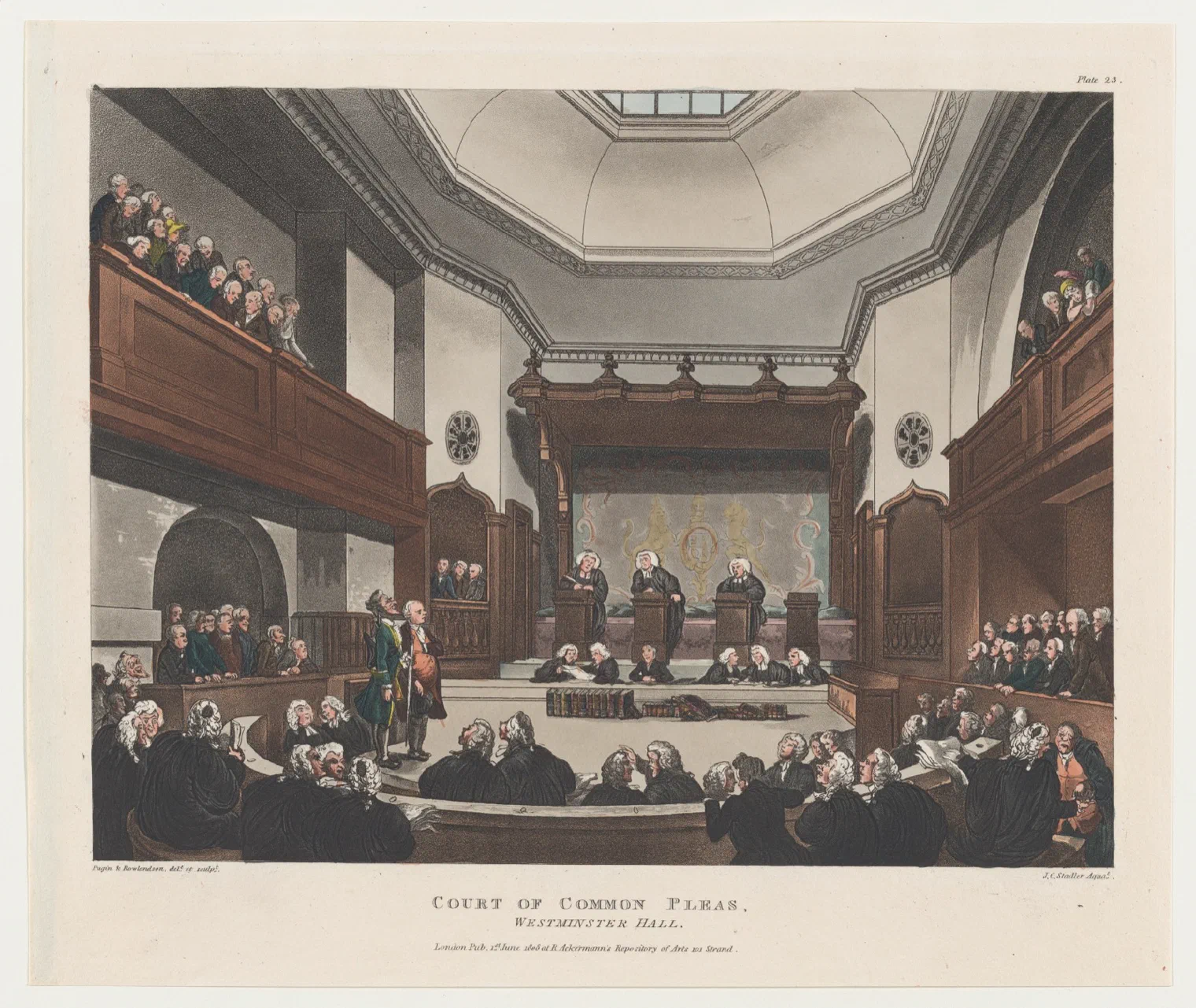
Nobody in the courtroom was fooled. The judges knew it was an act and went along with it, because it had been done this way for over three hundred years, and because they did not like land being tied up for ever either. It was really just a slow, fiddly piece of paperwork dressed up as a trial. It was held in the Court of Common Pleas, the courtroom in the picture at the top of this post.
(For those who like the details: there was a small extra piece of theatre. In the middle of the case, a court official would be called in to “defend” the land, and would then quietly walk out and never come back. Blackstone gives the whole script and names the usual stand-in, Jacob Morland, “usually the crier of the court”.)
Who could do it?
This is the important part. Not everyone could start a common recovery. Only a man who held the entail himself could, and he had to be a grown man of sound mind.
So everything depends on how Mr. Bennet held Longbourn, and there are two possibilities.
If Longbourn’s entail was Mr. Bennet’s own, he could have done this by himself, at any time, and Mr. Collins would never have seen a penny. He could have left Longbourn to Jane, or to all five girls. In that case Mr. Collins would simply be the heir presumptive: the man who inherits if nothing changes, with no say in the matter until then. And Mr. Bennet’s failure to act would be even harder to forgive.
If Mr. Bennet held Longbourn only for his lifetime (the likeliest reading, as we saw above), he could not do it alone. He needed the help of the next man in line who held the entail. And with no son, the next man in line was… Mr. Collins.
Which is it? Many Pride and Prejudice variations call Mr. Collins the heir presumptive, and I did so myself in Comeuppance. But Austen never uses the phrase. She has Mr. Collins describe himself only as “next in the entail of Longbourn estate”, which fits either reading. So either can be applied to Longbourn, though her word “join” leans towards the second.
That is the real sting of the Longbourn entail. The only person who could have helped Mr. Bennet cut Mr. Collins out was Mr. Collins himself. The two of them would have had to go to court together. Mr. Collins would not have to wait for Mr. Bennet to die. In this reading his place in the entail is a real legal right from the start, so he could join Mr. Bennet in court while Mr. Bennet was still alive. If he were merely the heir presumptive, as in the first reading, there would be nothing for him to give up, and nothing for him to join in. Mr. Collins would have had no reason to agree, unless Mr. Bennet paid him handsomely to give up his future estate. And Mr. Bennet, who had saved nothing, had very little to offer him.
How much did it cost?
Less than you might think, for the lawsuit itself. An official inquiry into the Irish courts in 1817 found that an ordinary recovery cost about £20 to £25 in court fees, clerks’ and lawyers’ charges and stamp duty (Fifth Report of the Commissioners of Inquiry into Courts of Justice in Ireland, 1819). With the deeds a lawyer drew up around it, an English recovery on an estate like Longbourn probably came to something like £30 to £60: a week or two of Longbourn’s income.
The real cost was Mr. Collins. An estate of two thousand a year was worth perhaps fifty thousand pounds, and even a claim he might have to wait twenty years for was worth thousands. A sympathetic Mr. Collins who asked nothing would have made the whole business about as costly as a good carriage.
If there had been a son, why break the entail at all?
A son would have kept Longbourn safe from Mr. Collins. But Austen says the son “was to join in cutting off the entail”, and in the same sentence she gives the reason: so that “the widow and younger children would by that means be provided for.”
That was the problem a son did not solve. Longbourn brought in two thousand pounds a year. Under the entail, all of it would go to the son when Mr. Bennet died. Mrs. Bennet and the girls would get nothing from the estate, only whatever the son chose to give them.
Breaking the entail would fix that. Once father and son had freed the land, Mr. Bennet could borrow against it, or sell a farm or two, and put money aside in writing: so much for each daughter, so much a year for his widow. The son would still get Longbourn, but his mother and sisters would be safe whatever he did.
That was the plan. It needed a son. Five daughters later, there was no son, and no plan.
When it ended
The pretend lawsuit was abolished by the Fines and Recoveries Act 1833. From 1834, a man could break an entail by signing an ordinary document instead.
Other ways round an entail
Only the common recovery, or an Act of Parliament, actually broke an entail. The rest were ways of providing for a family in spite of one.
- Ask Parliament. A family could ask Parliament to pass a special law allowing entailed land to be sold. Slow and expensive, but it worked when nothing else would.
- Buy more land. An entail covered only the land in the document. Anything bought later was the owner’s to leave as he liked. (Frederick does exactly this in Book Three, buying land next to Fernside “held in his own name rather than that of the estate, and therefore free from the entail”.)
- Save. The dullest way, and the one Mr. Bennet never tried. An estate of two thousand a year could have put away a good sum for his daughters over twenty years.
- Marry the heir. Mrs. Bennet’s plan, and Mr. Collins’s own idea. If one of the Bennet girls married him, Longbourn stayed in the family. We all know how that went.
A few more questions
How soon could the heir move in?
Straight away. The estate passed at the moment of death. Mrs. Bennet’s fear that “the Collinses will turn us out, before he is cold in his grave” was dramatic, but not wrong. Any breathing space depended on the heir’s good manners.
What would Mrs. Bennet live on?
Not the estate. A widow usually lived on money set aside in her marriage settlement, agreed before the wedding. Austen tells us: “Five thousand pounds was settled by marriage articles on Mrs. Bennet and the children.” The interest on that, perhaps two hundred pounds a year, would be most of what the family had to live on: enough for a small house and a servant or two, not much more.
And Charlotte?
If Mr. Collins inherited Longbourn and then died, Charlotte’s position would depend on whether they had a son. If they did, Longbourn would be his, and she would stay as his mother. If not, it would go to some Collins cousin, and Charlotte would find herself exactly where Mrs. Bennet had stood. Charlotte, of all people, would have understood that.
When did entails end?
Slowly. In 1833 they became easier to break. In 1925 the Law of Property Act weakened them further. Since 1997, nobody in England and Wales has been able to create a new one.
Back to Fernside
The best joke in Bingley’s letter is his own. Caroline has spent a year looking down on the Bennets for their entailed estate, and now:
“The gentleman now in our drawing room is in much the same circumstances, with an estate of similar size to Longbourn which is entailed on the male line. She does not appear to have observed it.”
Whether she notices in time, and what Westmorland makes of her, is a story for the book.
By Trade and by Trust is Volume Two of By Patience and by Paper. You can find it here.
Sources and further reading
- William Blackstone, Commentaries on the Laws of England (1765–69): Book 2, chapter 7 on entails and how they could be broken; Book 2, chapter 21 on the pretend lawsuit (the common recovery); Book 4, chapter 29 on what a convicted felon lost. (Avalon Project, Yale Law School.)
- Peter A. Appel, “A Funhouse Mirror of Law: The Entailment in Jane Austen’s Pride and Prejudice”, Georgia Journal of International and Comparative Law 41 (2013). A law professor on what Longbourn’s entail could and could not have been.
- Lynda A. Hall, “Entail, Elopement, and Marriage Law in Pride and Prejudice”, Persuasions On-Line 44.1 (2023).
- The National Archives, catalogue description of series C 211, on how the Lord Chancellor looked after the estates of the insane.
- Commissioners of Inquiry into Courts of Justice in Ireland, Fifth Report (Court of Common Pleas), with appendix (1819). Evidence taken in 1816–17 on the fees and charges for an ordinary recovery.
- Cestui que Vie Act 1666, legislation.gov.uk.
- Jane Austen, Pride and Prejudice (1813), chapters 7, 13 and 50, Project Gutenberg.
- Wikipedia, for quick overviews: Fee tail, Common recovery, De Donis Conditionalibus, Fines and Recoveries Act 1833, Corruption of Blood Act 1814, Coparcenary, Presumption of death, Bethlem Royal Hospital.
Comments
No account needed. Give a name, or leave it blank to post as Anonymous. Comments appear once the author has read and approved them.
Loading comments…