“This Is No Separation in Law”: How Divorce Worked in Regency England
Why ending a marriage in 1813 took a church court, a lawsuit and an Act of Parliament, and why the woman always paid.
In By Trade and by Trust, the second book of By Patience and by Paper, Frederick Lowe offers his unhappy wife Caroline a way out of their marriage. She may go back to London and live as she pleases, and he will not interfere. Then he adds:
“This is no separation in law, Caroline, and you are sensible, I think, that a divorce is scarcely to be considered. I would not bring such a charge against any woman.”
To a reader today that sounds odd. Why would a divorce be a charge? And why would refusing one be the kind thing to do?
The answer is that divorce in 1813 was nothing like divorce now. Here is how it worked, as plainly as I can put it.
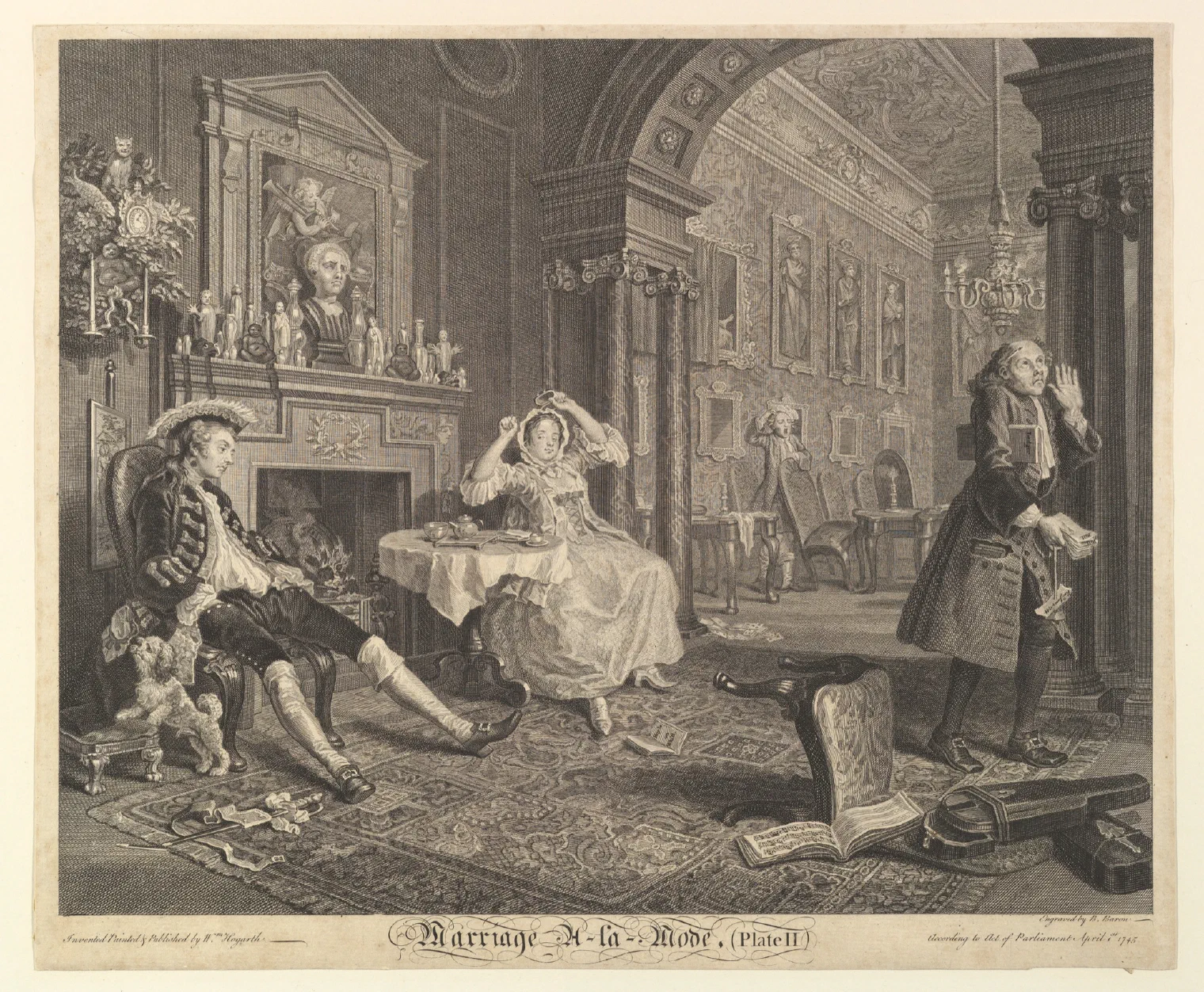
First, who was in charge of marriage?
Not the ordinary courts. In England, marriage belonged to the Church. Questions about whether a marriage was valid, or whether a couple might live apart, went to the church courts, which ran on church law.
And the Church’s position was simple: a valid marriage could not be undone. “Till death us do part” was meant literally.
So there was no form to fill in and no “we have grown apart.” There were only three narrow doors, and each was harder than the last. (The historian Lawrence Stone tells the whole story in Road to Divorce: England 1530–1987, and his opening point is a startling one: until 1857 England was the only Protestant country with almost no way to obtain a full divorce.)
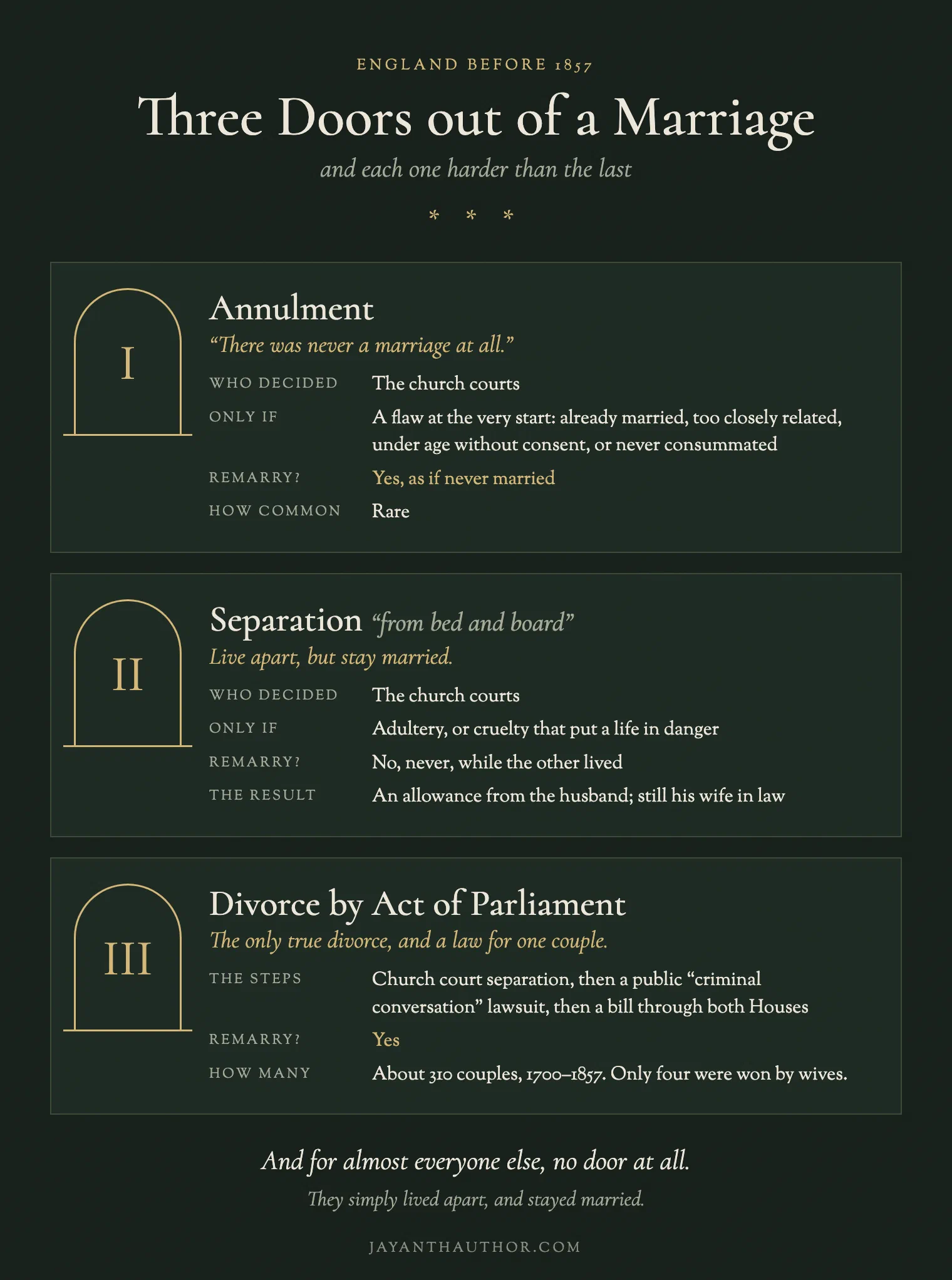
Door one: annulment
An annulment did not end a marriage. It declared that there had never been a real marriage in the first place.
That was possible only for a defect at the very start. For example:
- one of them was already married to someone else;
- the couple were too closely related;
- one was under age and had married without a parent’s consent (after Lord Hardwicke’s Marriage Act of 1753, such a marriage in England was void);
- the marriage was never consummated.
Annulments were rare, and the bar was high: when the Earl of Essex tried to escape his marriage in 1613 by claiming non-consummation, the case became a national scandal. Most unhappy couples had married perfectly legally, so this door was closed to them.
Door two: separation “from bed and board”
The church courts could grant what was confusingly called a divorce a mensa et thoro, Latin for “from table and bed.”
In plain terms, this was a legal separation. The couple could live apart, and the husband was usually ordered to pay his wife an allowance. But they were still married. Neither could marry again.
The grounds were few: adultery, or cruelty serious enough to put a life in danger. Unkindness, coldness or plain misery did not count.
Door three: full divorce, by Act of Parliament
This was the only way to end a marriage completely, so that a person was free to marry again. And it was extraordinary: each divorce needed its own private Act of Parliament, a law passed for one couple.
A husband usually had to go through three stages:
- The church court, to win a separation on the ground of his wife’s adultery.
- A lawsuit for “criminal conversation”, in which he sued his wife’s lover for damages, as if he had been robbed of property. These trials were public, and the newspapers printed every detail they could get.
- A bill in Parliament, debated in the House of Lords and then the Commons, with witnesses examined.
It took years and a great deal of money. Only the very rich could attempt it. Between 1700 and 1857 there were only about three hundred of these divorces in the whole country. The History of Parliament counts 310.
The double standard
Notice whose adultery the system was built around: the wife’s.
A husband could get a parliamentary divorce by proving his wife had been unfaithful. A wife could not get one for her husband’s adultery alone. She had to prove something worse on top of it, such as incest or bigamy.
In all those years, only four women ever obtained a divorce by Act of Parliament: Jane Addison in 1801, Louisa Turton in 1831, Ann Battersby in 1840 and Georgina Hall in 1850.
The case of Jane Addison
Jane Campbell, a Scotswoman, married Edward Addison. Between 1794 and 1796 he had an affair with her own married sister, Jessy. Under church law a wife’s sister counted as the husband’s own sister, so this was treated as incestuous adultery, and that “something worse” was what finally opened Parliament’s door to a wife.
Parliament passed the Addison divorce Act on 23 June 1801. Jane was even given custody of her children, which was almost unheard of, because her husband was judged unfit to raise them. The original Act is still kept in the Parliamentary Archives, and the History of Parliament has written up her story and how the Lords handled women’s petitions in the years after.
What happened to the woman
This is the heart of Frederick’s line. To divorce his wife, a husband had to accuse her, publicly and formally, of adultery. There was no other route. Whether it was true or not, she came out of it branded.
And under the law of the day, she had very little to fall back on:
- Her money was not hers. When a woman married, her property passed into her husband’s control. The lawyer William Blackstone summed up this rule, called coverture, in 1765: “the husband and wife are one person in law”, and that person was the husband.
- Her children were not hers. By law they belonged to the father. A divorced or separated mother could be kept from them entirely. This did not begin to change until the Custody of Infants Act 1839, won largely by the campaigning of Caroline Norton, whose husband had taken her sons from her. Even then, a mother could ask only for custody of children under seven.
- Her place in society was gone. A divorced woman was not received in respectable houses. Her family’s name suffered with her.
The man, meanwhile, could marry again and carry on much as before.
So when Frederick says he “would not bring such a charge against any woman,” he is not talking about paperwork. He is saying he will not destroy a woman’s name to free himself, even a wife who has made him unhappy. Caroline understands that at once.
What most unhappy couples actually did
Since divorce was out of reach for almost everyone, most couples who could not live together simply lived apart and stayed married.
Sometimes they signed a private deed of separation, a contract setting out where each would live and what the husband would pay. Sometimes there was no paper at all, only an understanding. A husband might keep the country house and the wife take lodgings in town, or the reverse.
That is exactly what Frederick offers Caroline: no court, no scandal, no accusation. She keeps his name, her allowance and her standing, and the door of the house stays open to her.
Among the poor, where none of this was affordable, people found rougher ways out. Some simply walked away. In a few places there was even the strange custom of a “wife sale” at a market, which had no force in law at all. Thomas Hardy built The Mayor of Casterbridge around one.
Over the border, things were different
Scotland had its own law. There, either a husband or a wife could go to court and divorce for adultery (from 1560) or for desertion (from 1573), as the National Records of Scotland explain. It was cheaper, more equal, and far less dramatic. English couples could not simply cross the border to use it, though.
When it changed
In 1857 the Matrimonial Causes Act took divorce away from Parliament and the church and gave it to a new Divorce Court. It was still expensive and still unequal: a husband needed only to prove adultery, while a wife needed adultery plus something else, such as cruelty or desertion.
Men and women did not stand on the same ground until the Matrimonial Causes Act 1923, which at last let a wife divorce her husband for adultery alone.
Back to Fernside
Frederick Lowe is not a romantic hero in any obvious way. He is stiff, private and hard to read, and Caroline has given him little reason to be generous. That is what makes the line matter. In a world where the law handed a husband every weapon, he chooses not to pick one up.
What Caroline does with that choice is a story for the book.
By Trade and by Trust is Volume Two of By Patience and by Paper. You can find it here.
And if you are wondering how all these couples were married in the first place, the post before this one explains: “You Must and Shall Be Married by a Special Licence”: How to Get Married in Regency England.
Sources and further reading
- Lawrence Stone, Road to Divorce: England 1530–1987 (Oxford University Press, 1990). The standard history, covering every route described above.
- The History of Parliament, “Jane Campbell: parliamentary divorce pioneer” (2016).
- The History of Parliament, “Attitudes to women’s petitions for divorce by Act of Parliament, 1801–1831” (2022). The steps of a parliamentary divorce, and the four women who obtained one.
- The History of Parliament, “Three degrees of separation: alternatives to divorce in early modern England” (2021). Annulment, formal separation and simply walking away.
- UK Parliament, Living Heritage: Relationships: key dates and the Addison–Campbell Divorce Act 1801.
- William Blackstone, Commentaries on the Laws of England, Book 1, chapter 15 (1765), on a married woman’s place in law.
- National Records of Scotland, History of divorce in Scotland.
- Women’s Legal Landmarks, Matrimonial Causes Act 1923.
- Wikipedia, for quick overviews: Divorce in England and Wales, Matrimonial Causes Act 1857, Custody of Infants Act 1839, Jane Addison, Wife selling.
Comments
No account needed. Give a name, or leave it blank to post as Anonymous. Comments appear once the author has read and approved them.
Loading comments…